
Florida’s private security industry is currently one of the fastest-growing employment sectors in the state, yet the path to opening a training facility is often blocked by a single, 40-hour hurdle. If you are researching how to start a security school in florida, you likely already recognize the massive demand for licensed officers in our residential communities, hospitals, and corporate offices. It's natural to feel a sense of hesitation when faced with the intricate web of Chapter 493 regulations or the precision required for state approval. You want to ensure your facility stands as a beacon of professional excellence rather than getting lost in a sea of paperwork.
This guide provides the exact roadmap you need to navigate the Class DS licensing process, secure a compliant curriculum, and meet the rigorous standards set by the Florida Department of Agriculture and Consumer Services. Whether you're transitioning from a career in law enforcement or expanding an existing security firm, we offer a clear path toward establishing a state-certified training center. We'll examine the specific instructor credentials required for a Class DI license, the nuances of the 170-question final examination, and the essential steps to obtaining a professional 40-hour curriculum that meets every state mandate. Discover how to transform your vision into a fully operational, compliant reality.
Key Takeaways
- Master the fundamental legal framework by learning how to start a security school in florida through strict adherence to Florida Statutes Chapter 493.
- Secure your Class DS license by following a methodical application process that covers business registration and facility compliance.
- Identify the specific professional experience and credentials required to qualify your staff for the mandatory Class DI instructor license.
- Implement a state-compliant 40-hour curriculum that addresses all mandated subjects, from legal liability to emergency response protocols.
- Build strategic partnerships with local security agencies to facilitate student placement and establish your school as a trusted industry leader.
Understanding the Legal Framework: Florida Statutes Chapter 493
Establishing a training facility requires more than just a classroom and a lesson plan. The Florida Department of Agriculture and Consumer Services (FDACS) serves as the watchful guardian of the private security industry, ensuring every professional meets high standards of conduct and knowledge. For those learning how to start a security school in florida, Florida Statutes Chapter 493 is your definitive guide. It's often called the bible of the industry because it outlines every legal obligation you'll face. Ignoring these statutes isn't just a mistake; it's a risk to your business's survival. State fines are steep, and the Division of Licensing won't hesitate to revoke a license for repeated non-compliance.
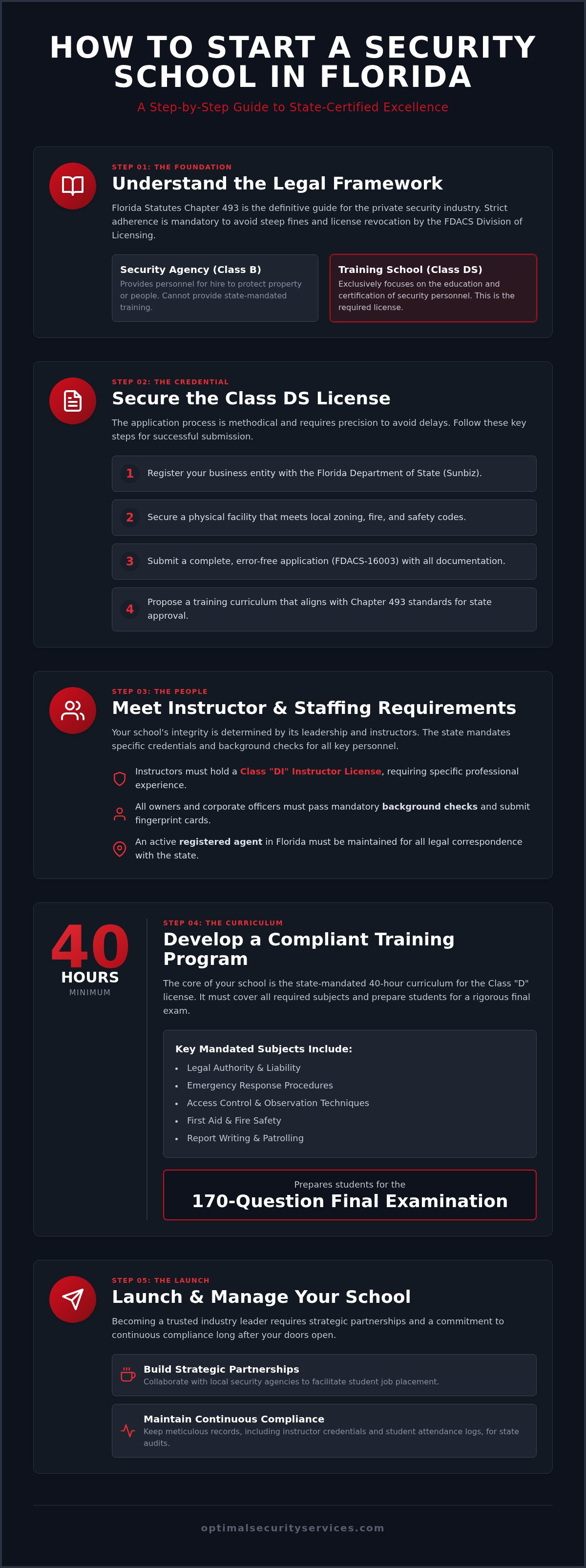
It's vital to distinguish between a security agency and a training school. A security agency, operating under a Class B license, provides personnel for hire to protect property or people. In contrast, a security training school focuses exclusively on the education and certification of those personnel. You can't legally provide state-mandated training under an agency license alone. Understanding this distinction is the first step in your journey to becoming a state-certified educator.
The Class DS Training School License
The Class DS license is the specific credential that authorizes you to operate a training facility. It's a separate entity from any agency license you might hold. Whether you're training new recruits for residential patrol or preparing seasoned professionals for high-risk assignments, your school must adhere to the same rigid standards. In 2026, eligibility requirements remain rigorous. Owners must be at least 18 years old and possess a clean criminal history. This license proves to the state that your facility is equipped to deliver the high-quality instruction necessary for the modern security landscape. Success begins with securing this license before you ever open your doors to students.
Regulatory Oversight by the Division of Licensing
The Division of Licensing maintains strict oversight to protect the public. They monitor everything from instructor credentials to student attendance logs. You're required to maintain an active registered agent in Florida to handle legal correspondence and ensure you're always reachable by the state. Compliance is a continuous process. It begins with a thorough understanding of the state-mandated training hours and extends to every record you file. If you want to know how to start a security school in florida that lasts, you must prioritize these administrative details from day one.
The Class DS License Application Process
Moving from the legal theory of Chapter 493 to the actual operation of a school requires a disciplined, step-by-step approach. To understand how to start a security school in florida, you must first register your business entity with the Florida Department of State. This filing provides the official name and structure for your training center. Once registered, you'll need to secure a physical location that satisfies both local zoning ordinances and state instructional requirements. This facility must be a dedicated space, as Florida requires even online instruction to originate from a licensed physical school within the state.
Securing a location involves verifying that the building meets fire and safety codes for educational use. This often necessitates inspections by local authorities before the state will grant a license. When you're prepared to submit the FDACS-16003 application, ensure your business name matches your Sunbiz filing exactly. Small discrepancies often lead to immediate rejection, which can delay your opening by months. Finally, you must submit a proposed training curriculum that aligns with the strict standards of Florida Statutes Chapter 493 for final state approval.
Required Documentation and Fees
Your application package must be comprehensive and error-free. It includes fingerprint cards for all corporate officers, passport-quality photographs, and verifiable proof of insurance. Background checks are mandatory for everyone with an ownership stake to ensure the high integrity of the training center. By 2026, the Division of Licensing has expanded its digital submission options, which significantly reduces processing times. Utilizing these online portals is the most efficient way to learn how to start a security school in florida without unnecessary delays. If you're looking to simplify your path to approval, utilizing a professional security training curriculum can streamline your state submission.
Insurance and Bonding Requirements
Insurance is a vital shield for your investment. You'll need general liability coverage that specifically addresses the unique risks of a training environment. Whether you're conducting classroom lectures or practical field exercises, your policy must meet the state's minimum requirements for a training facility. Some Florida jurisdictions may also require a surety bond to protect students and the public. This serves as a financial guarantee that your school will fulfill its contractual obligations. We recommend partnering with an insurance provider who understands the specific needs of the security sector. This ensures your coverage is as robust as the training you provide. Once your protection is in place, you can move forward with confidence.
Instructor and Facility Requirements
While the initial paperwork establishes your business entity, your instructors and physical facility define your school's reputation. When entrepreneurs ask how to start a security school in florida, they often focus on the building, but the state prioritizes the person standing at the front of the room. A training center is only as strong as the expertise it delivers. You must ensure your staff doesn't just possess the knowledge, but also the specific state-mandated credentials to share it. This transition from a security professional to an educator requires a shift in mindset and a strict adherence to Florida's official licensing requirements.
Qualifying for the Class DI License
The Class DI license is the mandatory credential for teaching the D course. To qualify, a prospective instructor must be at least 18 years old and hold a high school diploma or its equivalent. The state requires significant field experience; an applicant must have been licensed as a Class D security officer for at least three of the preceding five years. Alternatively, holding a Class M or MB manager license can fulfill this experience requirement. This ensures that every student learns from a seasoned professional who understands the practical realities of the industry. When you're building your team, look for individuals who embody the discipline and precision your school aims to project.
Classroom Standards and Inspections
Your facility must be more than just a room with chairs. Florida requires a professional environment that facilitates learning and meets all local building and safety codes. This includes adequate lighting, comfortable seating, and the necessary instructional aids to deliver a comprehensive 40-hour security training curriculum effectively. The Division of Licensing mandates that your school and instructor licenses be prominently displayed for all students and visitors to see. This transparency reinforces your school's legitimacy and commitment to state standards.
Preparing for unannounced inspections is a critical part of knowing how to start a security school in florida successfully. Division of Licensing investigators may visit your facility at any time to audit student attendance logs, review graded examinations, and ensure your instructional methods remain compliant. They'll verify that your student-to-instructor ratios allow for effective learning and that your facility remains a safe, disciplined environment. Maintaining meticulous records and a clean, organized classroom isn't just about passing an inspection; it's about providing the high-quality training that your students deserve. A well-managed facility serves as a silent testament to your school's professionalism and dedication to the craft.
Developing a Compliant 40-Hour Security Training Curriculum
The core of your training facility is the educational material you provide. Florida law mandates a minimum of 40 hours of instruction for any student seeking a Class D license. This isn't just a suggestion; it's a rigid requirement enforced by the state. When you're figuring out how to start a security school in florida, you'll quickly realize that building a curriculum from scratch is one of the most significant barriers to entry. Your materials must align perfectly with the "Security Officer Training Curriculum Guide P-01878," a document that sets the standard for every licensed facility in the state. Failing to meet these specific instructional standards can lead to immediate rejection of your school's application.
Many entrepreneurs spend months trying to draft their own manuals, only to have them rejected during a state audit. This delay can be costly and frustrating. Utilizing a pre-approved Security D License Training Curriculum allows you to bypass these hurdles and move directly toward your grand opening. It's the most reliable way to understand how to start a security school in florida while maintaining total compliance. It ensures your students receive high-quality, professional instruction that meets every legal benchmark without the trial and error of DIY development.
Mandatory Course Topics for the Class D License
Your 40-hour course must cover a specific range of subjects designed to prepare officers for the field. You'll need to provide in-depth instruction on Florida Statutes, particularly those regarding legal authority and the scope of practice. Beyond the law, your training must emphasize ethics, professionalism, and public relations. These soft skills are vital for maintaining safety and peace of mind in high-traffic environments. Additionally, students must master practical patrol techniques, observation skills, and the art of precise documentation. A security officer's report is often a legal document; teaching them to write it correctly is a fundamental duty of your school.
Testing and Certification Procedures
Once the 40 hours of instruction are complete, the state requires a final examination to verify student competency. This exam must be at least two hours long and consist of 170 questions. To pass, a student needs to answer at least 128 questions correctly. No more than 50% of the questions in any subject area can be true or false, ensuring a rigorous assessment of their knowledge. After a student passes, you'll issue a Certificate of Security Officer Training using Form FDACS-16103. You're also required to maintain detailed records for each student, including their graded exams and attendance logs, for a minimum period as dictated by state law. If you're ready to secure your facility's future, invest in a compliant training curriculum today.
Launching and Managing Your Florida Security School
Launching your school marks the transition from regulatory compliance to active commerce. When considering how to start a security school in florida, you must look beyond the initial license and toward the community you serve. Marketing your services to the Miami and broader Florida security industry requires a focus on reliability and student outcomes. Building strategic partnerships with local security agencies is essential; these firms are your primary partners for student placement. By ensuring your graduates are job-ready, you create a pipeline that benefits the agencies and establishes your school's reputation. Managing your facility also involves staying updated on annual legislative changes in Tallahassee, a critical part of knowing how to start a security school in florida that remains compliant over the long term. You can look to the leading security officer training school in Florida to model your success.
Modeling Success in the Florida Market
Differentiating your school is the key to sustainable growth. You can set your facility apart by offering specialized training modules that go beyond the state basics, such as advanced de-escalation or site-specific protocols. Integrating modern technology, such as digital reporting software and electronic attendance tracking, prepares your students for the high-tech environments they'll encounter in the field. This forward-thinking approach ensures your training remains relevant as the industry evolves. Use a 2026 evaluation checklist to ensure your school meets top-tier standards and maintains a competitive edge in the market. Precision in your instructional delivery builds lasting trust with both students and employers.
Your Partnership with Optimal Security
You don't have to navigate the complexities of school management alone. Optimal Security supports new training facilities by providing the expert curriculum solutions necessary to meet Florida's rigorous standards. We understand the challenges of maintaining a state-certified program and offer the resources to help you succeed from day one. Whether you're refining your instructional techniques or expanding your course offerings, we serve as a steadfast partner in your professional journey. Requesting a consultation can jumpstart your training facility and provide the clarity needed for long-term operations. Take the final step toward your goal and contact Optimal Security to secure your training curriculum today. We are dedicated to your success and the safety of the communities your graduates will protect.
Securing Your Future as a Florida Training Authority
Establishing a certified training center is a significant undertaking that requires a meticulous approach to state regulations and educational standards. You've learned that mastering the legal framework of Chapter 493 and securing the correct Class DS and DI licenses are the foundational pillars of your business. By focusing on a professional facility and a disciplined instructional environment, you set the stage for long-term success in this growing industry.
The final and most critical step in understanding how to start a security school in florida is the implementation of a compliant, high-quality curriculum. You don't have to tackle this complex development process alone. As state-compliant curriculum specialists with deep expertise in Florida Chapter 493, we are trusted by security professionals across the state to provide the educational tools they need for success.
Get the Professional Curriculum You Need to Launch Your Florida Security School. Take the first step toward opening your doors with confidence and precision. Your journey toward becoming a leader in security education begins with the right partner by your side.
Frequently Asked Questions
How much does it cost to start a security school in Florida?
Starting a security school involves several state-mandated costs. The initial application fee for a Class DS license is $60, while each instructor must obtain a Class DI license for an additional $60. Beyond these state fees, you'll need to budget for business registration, facility leasing, and insurance. It's also vital to invest in a professional curriculum. While total startup costs vary based on your location and facility size, these licensing fees remain a consistent baseline for everyone researching how to start a security school in florida.
What is the difference between a Class DS and a Class DI license?
The Class DS license is specifically for the training facility or school entity itself, authorizing it to provide security instruction. In contrast, the Class DI license is the individual credential required for the instructors who teach the courses. A school must hold a DS license, and every person providing instruction at that facility must maintain an active DI license. This dual-licensing system ensures that both the business and the educators meet Florida's high standards for professional security training.
Can I teach the Florida Class D security course online?
Yes, you can offer online training, but it must be conducted live with simultaneous participation from the instructor and students. The state requires that the instruction originates from a licensed school or training facility located within Florida. You must use a secure website with SSL or TLS technology and verify every student's identity with a government-issued photo ID. These regulations ensure that remote learning maintains the same level of integrity and oversight as traditional in-person classroom instruction.
How long does the FDACS approval process take for a new school?
The approval process for a new security school typically takes several weeks, though the exact timeline depends on the completeness of your application. The Division of Licensing must review your business registration, fingerprints, and proposed curriculum. Utilizing digital submission options available in 2026 can significantly speed up this process compared to traditional mail. Ensuring your 40-hour curriculum is fully compliant with Chapter 493 from the start is the most effective way to avoid delays and secure your approval quickly.
Do I need to be a licensed security officer to own a security school?
You don't need to be a licensed security officer to own a security school, but you must meet specific state eligibility requirements. Owners must be at least 18 years old and possess a clean criminal history to pass the mandatory background check. While the owner doesn't need field experience, the individuals actually teaching the courses must hold a Class DI license. This requires them to have been licensed as Class D officers for three of the preceding five years.
What insurance is required for a security training facility in Florida?
Florida requires training facilities to maintain general liability insurance to protect against risks associated with classroom and practical instruction. This coverage is a mandatory part of your Class DS license application. While the state sets minimum standards, many school owners choose higher coverage limits to ensure comprehensive protection for their business and students. Some local jurisdictions may also require a surety bond. Always consult with an insurance provider who specializes in the private security industry to ensure your policy is fully compliant.
How often do I need to renew my Florida security school license?
Your Florida Class DS school license and Class DI instructor licenses must be renewed every two years. The Division of Licensing typically sends renewal notices well in advance of the expiration date. It's your responsibility to maintain active status to avoid heavy state fines or the temporary closure of your facility. Keeping your records organized and your curriculum updated ensures a smooth renewal process. This consistent oversight helps maintain the high quality and dependability of the Florida security training sector.
Can a security training school also be a licensed security agency?
Yes, many businesses operate as both a training school and a security agency, but they must hold separate licenses for each function. You would need a Class DS license for the school and a Class B license for the agency. This allows you to train your own recruits and provide them with immediate employment opportunities. When learning how to start a security school in florida, many entrepreneurs find that this dual-model provides a steady pipeline of qualified personnel for their protective service operations.


