
Could a single mistake from your past permanently block your path to a stable, rewarding career in professional protection? It's a question that weighs heavily on many aspiring professionals who are ready to serve but feel uncertain about the strict legal standards of Florida Statute 493. You likely understand that the security industry demands a high level of integrity, yet the complexity of state regulations can make the path forward feel obscured by red tape and legal jargon. Many applicants spend hours wondering exactly what disqualifies you from getting a security license in florida before they feel comfortable investing time in a training program.
This guide offers the definitive roadmap you need to secure your Class D license in 2026 with total peace of mind. We will break down the eligibility requirements, from fingerprinting fees to the specific timelines for past legal issues, ensuring you have a transparent view of the process. You'll discover the exact steps to complete your mandatory 40 hour training at a state approved school and how to submit a flawless application to the FDACS. Whether you're transitioning from another field or starting your professional journey, this comprehensive walkthrough prepares you for a successful entry into the workforce.
Key Takeaways
- Understand the legal framework of Florida Statute Chapter 493 and why the Class D license is the mandatory credential for every professional unarmed officer in the state.
- Identify specific background check criteria and what disqualifies you from getting a security license in florida to ensure your eligibility before beginning the application process.
- Navigate the mandatory 40-hour instructional curriculum and learn how to select a state-approved school that balances technical expertise with professional career guidance.
- Master the step-by-step certification timeline, from completing your initial training hours to successfully passing the required state examination.
- Learn how to leverage your new credentials to enter the 2026 workforce quickly and secure positions in high-tier security environments.
Understanding the Florida Class D Security Officer License
The Florida Class D Security Officer License serves as the foundational credential for anyone seeking employment in the state's private security industry. This mandatory certification ensures that every individual tasked with protecting property or people has met rigorous state standards for training and background eligibility. Governed by Florida Statute Chapter 493, the license is strictly regulated to maintain public safety across residential communities, commercial high-rises, and large-scale public events. The Florida Department of Agriculture and Consumer Services (FDACS), Division of Licensing, provides the necessary oversight to ensure that only qualified professionals enter the workforce. Understanding the Role of a Security Officer involves recognizing that this position is a matter of legal compliance and deep public trust.
Before you begin your training at a licensed facility, it's essential to understand the eligibility requirements. Many applicants feel anxious about their past, specifically regarding what disqualifies you from getting a security license in florida. While the FDACS maintains high standards, the path is often clearer than people expect once you understand the specific criteria. Professional certification isn't just a administrative hurdle; it's a mark of readiness that separates high-tier professionals from untrained personnel. It establishes your authority and provides the legal protection you need to perform your duties effectively.
The Legal Framework of Chapter 493
Florida law is precise when defining the duties of a security officer. Chapter 493 outlines the legal boundaries of your authority, focusing on observation, reporting, and incident deterrence. These state-mandated standards exist to protect the public and the officer alike. Performing security duties without a valid Class D license is a serious violation that can lead to criminal charges or heavy fines for both the individual and the employer. It's a high-stakes industry that demands total adherence to the law. Compliance ensures your career starts on a foundation of integrity and legal safety.
Class D vs. Class G Licenses
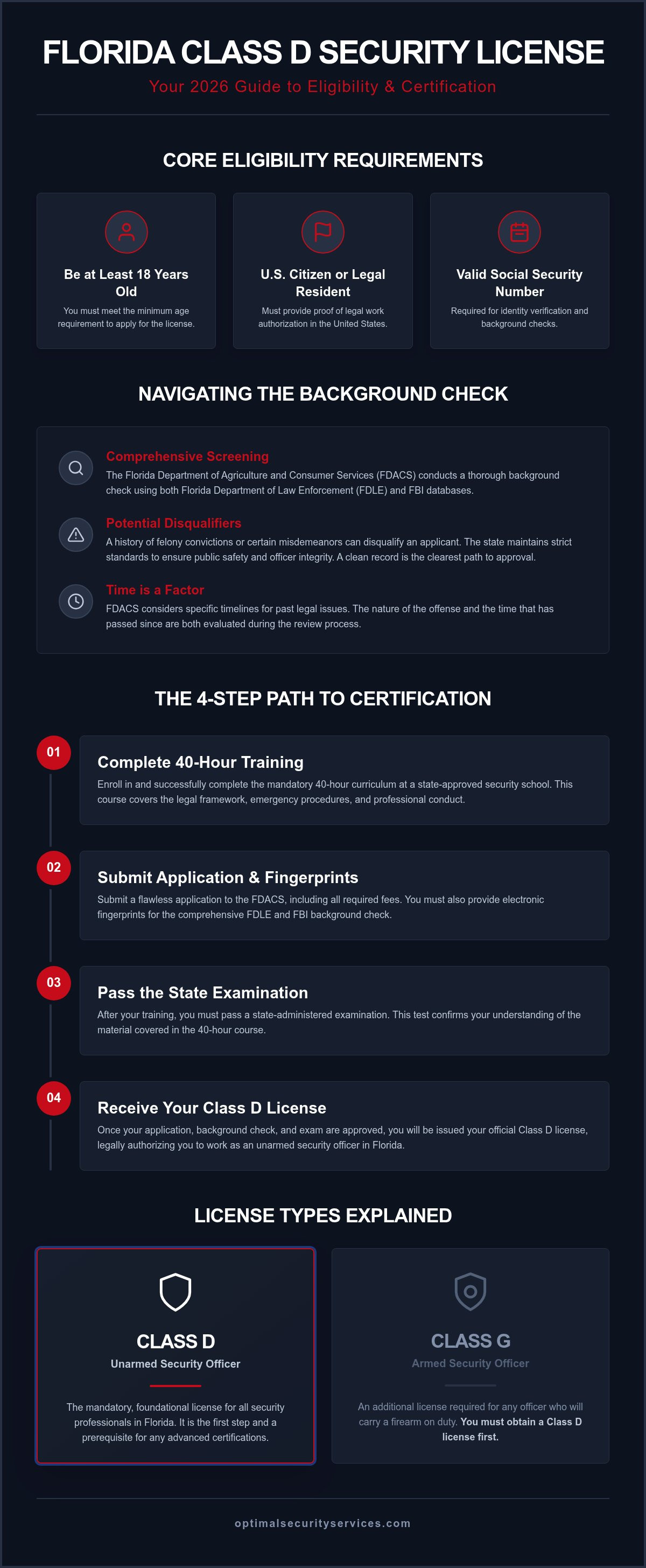
It's vital to distinguish between the various levels of certification available in the Sunshine State. The Class D license is for unarmed security officers, whereas the Class G license is an additional certification required for those who carry a firearm while on duty. You cannot obtain a Class G license without first securing your Class D credential. This tiered system ensures that every armed professional has a solid foundation in basic security principles before advancing to more complex responsibilities. For a deeper look at the process, explore our guide on Security License Training in Florida: The Complete 2026 Guide to Your Class D License. Secure your foundation first to open doors to advanced opportunities later.
What Disqualifies You from Getting a Security License in Florida?
Securing a Class D license requires more than just completing a training course; it demands a clear history that aligns with the state's rigorous safety standards. Understanding what disqualifies you from getting a security license in florida is the most critical step you can take before submitting your paperwork to the FDACS. The state conducts a comprehensive background check using both FDLE and FBI databases to ensure every officer possesses the character and reliability necessary for public protection. While the standards are high, they are designed to be transparent, allowing you to assess your own eligibility with confidence before you invest in professional security training.
Age, Citizenship, and Residency Standards
Basic eligibility begins with your legal status and age. To apply for a Class D license, you must be at least 18 years old. You must also be a U.S. citizen or a legal resident alien with valid work authorization. The state requires a valid Social Security number as part of the application process. You can find the complete list of acceptable documentation in Florida's Official Class D License Requirements. These foundational rules ensure that every officer is legally permitted to work within the United States before they assume their duties.
Criminal Record and Felony Disqualifiers
Criminal history is the primary area where most applicants face challenges. A felony conviction is a permanent disqualifier unless your civil rights have been restored. Even then, Florida enforces a strict 10-year waiting period after the completion of all supervision before you become eligible for a license. Misdemeanors involving violence, such as battery or domestic violence, or crimes of dishonesty like theft and fraud, typically carry a 3-year waiting period from the date your sentence was completed. If your application is denied based on your record, you have the legal right to request a hearing to present your case, though the state's standards remain firm regarding public safety risks.
Beyond criminal records, the state evaluates your history of substance abuse and mental health. Having two or more DUI convictions within the three years preceding your application will lead to a disqualification. Similarly, a history of institutionalization for mental health reasons requires a medical clearance certificate from a licensed provider to move forward. Perhaps the most avoidable mistake is a failure to disclose. Falsifying or omitting information on your application, especially regarding your criminal past, results in immediate disqualification. Honesty is the first test of your professional integrity as a future security officer.
Navigating the 40-Hour Mandatory Training Curriculum
Once you've confirmed that you meet the state's eligibility criteria, the next phase of your professional journey involves the academic and practical training required by the FDACS. Florida requires a comprehensive 40 hour instructional program that serves as the backbone of your career. This curriculum isn't merely a series of lectures; it's a rigorous preparation process designed to equip you with the skills necessary to handle real world security challenges. While many students enter the classroom still concerned about what disqualifies you from getting a security license in florida, the training itself often provides the clarity needed to understand the high moral and professional standards the state expects.
The 40 hour course is divided into several modules that cover a broad spectrum of security operations. You'll move from learning about the foundations of Florida law to mastering the technical aspects of emergency response. This balanced approach ensures that every graduate is a capable protector and a disciplined professional. Key areas of focus include:
- Florida Statutes and Legal Boundaries: Deep dives into Chapter 493 and the specific laws governing private security.
- Emergency Preparedness: Critical training in first aid, CPR, and disaster management protocols.
- Professionalism and Ethics: Understanding the code of conduct required to maintain public trust.
- Field Operations: Mastery of observation techniques, patrol procedures, and incident documentation.
Legal and Liability Training
Understanding the limits of your authority is the most vital part of your legal education. In Florida, security officers must operate within strict boundaries to avoid personal and corporate liability. A core component of this training is distinguishing between your power to detain and the power to arrest. Detention involves a temporary hold for investigation based on reasonable suspicion, whereas an arrest is the formal taking of a person into custody to answer for a criminal charge. Proper training in these concepts protects you from legal repercussions and ensures that your actions remain defensible in a court of law.
Operational Skills and Report Writing
Beyond the law, your daily success depends on your ability to observe and communicate. You'll learn de-escalation strategies, often called "verbal judo," to resolve conflicts without physical intervention. These skills are paired with intensive report writing modules, where you'll practice documenting incidents with precision and objectivity. A well written report is often the only record of an event, making it a critical tool for law enforcement and insurance purposes. If you're ready to master these skills, choosing the right Leading Security Officer Training School in Florida: Your Career Starts Here is your most important next step. Professional readiness begins with a commitment to excellence in the classroom.
Step-by-Step Guide to the Florida Certification Process
The transition from student to licensed professional is a methodical journey that requires attention to detail and strict adherence to state timelines. Once you've completed your instructional hours, you must move through the state's administrative phases with precision. This ensures your background is fully vetted and your credentials are properly recorded by the Division of Licensing. Even at this stage, the state's comprehensive background check remains the final gatekeeper. It's the primary reason why understanding what disqualifies you from getting a security license in florida is so vital before you reach the fingerprinting desk. Every step in this process is designed to verify your readiness for the field.
Your path to certification follows a clear, four-phase structure:
- Phase 1: Select a state-approved facility and complete your 40-hour training.
- Phase 2: Successfully pass the mandatory final examination with a qualifying score.
- Phase 3: Schedule and complete your electronic Livescan fingerprinting.
- Phase 4: Submit your formal application and the total state fees of $97.75 to the FDACS.
Passing the State Exam and Fingerprinting
The final examination at your training facility is the culmination of your 40-hour commitment. Reviewing your course materials on Florida law and emergency procedures is the best way to ensure you're prepared. After passing, you'll need to locate a certified Livescan provider in your city. This electronic fingerprinting process is the modern standard for background checks. It's a quick, inkless procedure that sends your data directly to the FDLE and FBI. You'll also need a recent, clear passport-style photo for your ID. This image will be printed on your permanent hard card, so it must meet specific state dimensions and quality standards. Precision here prevents delays.
Filing Your Application with FDACS
You have two primary options for submitting your application: online through the FDACS portal or via traditional mail. The online method is generally faster and allows for easier tracking of your status. You'll need to pay the required fees, which cover the application, fingerprint processing, and a mandatory retention fee. Once submitted, you can monitor the Division of Licensing website to see where your application stands in the queue. While you wait for your permanent license, some employers may allow you to work if you've provided proof of your submitted application and training certificate. If you're ready to start this journey, you can enroll in security training to complete your first phase today.
Completing these steps with care demonstrates the discipline required of a professional officer. It's a structured process that rewards those who are proactive and organized. By following this guide, you ensure that your entry into the 2026 workforce is as smooth as possible. Don't let administrative errors slow down your career launch. Total compliance is the only path to success.
Launching Your Career with Professional Security Training
Earning your Class D license is a significant achievement, yet it's merely the first step toward a thriving career in the protection industry. To truly excel, you must leverage your certification to target high-tier roles that offer stability and growth. Many premier agencies seek candidates who not only possess the legal credentials but also exhibit a deep understanding of professional ethics and operational excellence. During your job search, you'll find that having a clear grasp of what disqualifies you from getting a security license in florida serves as a testament to your integrity. It shows employers that you've successfully navigated a rigorous vetting process and are a reliable, low-risk asset for their team.
Building a professional resume for the Florida market requires highlighting your 40 hour training and any specialized skills you acquired, such as de-escalation or incident report writing. Whether you're aiming for a position in a corporate high-rise or a residential community, your ability to present yourself as a disciplined expert is paramount. As you gain experience, you might consider advancing your career by pursuing a Class G license. This transition allows you to move from unarmed to armed roles, which significantly increases your earning potential and opens doors to specialized protection assignments across the state.
High-Demand Industries for Class D Officers
Florida’s diverse economy provides a wealth of opportunities for newly licensed officers. The hospitality and tourism sectors are particularly robust; hotels and resorts constantly seek professional staff to ensure guest safety and maintain a welcoming environment. Gated communities and corporate offices also represent high-demand areas where officers play a critical role in access control and property protection. Your performance during your initial training can often lead to immediate placements, as many firms prioritize graduates from reputable schools. These entry-level roles provide the essential experience needed to climb the professional ladder and secure specialized positions.
Why Optimal Security is Your Career Partner
Choosing the right training facility makes the difference between simply holding a license and being truly prepared for the field. We focus on more than just the basics; we prioritize legal mastery and professional readiness. Our curriculum is designed to ensure you understand every aspect of the industry, including a comprehensive review of what disqualifies you from getting a security license in florida. We remain committed to your success from the moment you enter the classroom until you enter the workforce. Start your professional security career at Optimal Security School today and join a community of dedicated protection professionals who value excellence and precision.
Securing Your Future in Florida’s Protection Industry
Launching a career in private security is a commitment to public safety and professional excellence. By mastering the legal requirements of Florida Statute 493 and completing your mandatory 40 hour training, you position yourself as a reliable asset in a high demand market. Whether you're seeking to protect residential communities or secure corporate environments, your journey begins with a clear understanding of state eligibility. Identifying exactly what disqualifies you from getting a security license in florida ensures that you can proceed with total confidence and avoid unnecessary delays during the FDACS vetting process.
Professional readiness requires more than just a certificate; it demands a foundation built on expertise and real world experience. Our state approved curriculum is led by expert instructors who provide the specialized training and dedicated Florida career guidance you need to excel from day one. Take the definitive step toward your new profession by choosing a partner committed to your success and long term growth. Enroll in Florida’s Premier Security Training Program today to begin your certification journey. We look forward to guiding you toward a stable and rewarding career in the protection industry.
Frequently Asked Questions
How long does it take to get a security officer certification in Florida?
Completing the mandatory 40 hour training course is the first step in your professional journey. Once you've finished the curriculum at a licensed school, you'll submit your application to the FDACS. Processing times for the Division of Licensing can vary based on current volume, but many applicants receive their hard card within a few weeks. It's best to plan for approximately one month from the start of your training to the receipt of your professional credentials.
Can I take the Florida security D license course online in 2026?
Yes, Florida law allows for the 40 hour Class D curriculum to be delivered through state-approved online platforms. However, it's essential to ensure the school is properly licensed and that you can complete any required in-person testing or fingerprinting locally. This flexibility allows you to balance your studies with other responsibilities while still meeting the rigorous standards set by Florida Statute Chapter 493 for professional security training.
What is the total cost of obtaining a security officer certification in Florida?
The total initial cost for the state application and background check is $97.75. This amount includes the $45 application fee, a $42 fingerprint processing fee, and a $10.75 retention fee. You should also account for the cost of professional training at a licensed facility. These state fees are paid directly to the FDACS and your Livescan provider to ensure your background is thoroughly vetted through the FDLE and FBI databases.
Will a misdemeanor on my record prevent me from getting certified?
A misdemeanor doesn't automatically bar you from the profession, but specific types of offenses carry mandatory waiting periods. Crimes involving violence, theft, or dishonesty typically require a 3 year waiting period after you've completed all aspects of your sentence. If you're unsure how your history affects your eligibility, consulting with a professional training school can provide clarity on the current FDACS standards for background approval and character requirements.
Do I need a high school diploma to get a security license in Florida?
Florida law doesn't strictly require a high school diploma or GED to obtain a Class D security license. The state's primary focus is on your age, legal residency status, and the successful completion of the 40 hour training course. You must be at least 18 years old and a U.S. citizen or legal resident alien. While the state doesn't mandate a diploma, many high-tier employers may require one for specific security roles.
How often do I need to renew my Florida Class D security license?
You are required to renew your Florida Class D security license every two years to maintain your legal authority to work. The FDACS will typically send a renewal notice to your address on file before the expiration date. The renewal fee is $45, and it's vital to submit your paperwork on time to avoid any lapse in your credentials. Staying current with your licensing is a key part of your professional responsibility.
Can I work while my Florida security license application is pending?
You generally cannot perform the duties of a security officer until your license has been approved by the state. While some employers might allow you to begin orientation or non-security tasks while your application is pending, you must have your Class D license in hand to work a post. Working without a valid license is a violation of Chapter 493 and could jeopardize your future eligibility for state certification.
What disqualifies you from getting a security license in Florida regarding drug tests?
A history of substance abuse that resulted in legal issues can be a significant hurdle for applicants. Specifically, having two or more DUI convictions within the three years preceding your application is a major factor in what disqualifies you from getting a security license in florida. The state seeks to ensure that every officer is capable of making sound, sober judgments while on duty. Failing to disclose past substance issues can also lead to an immediate denial.


