
Professional security training is more than a legal checkbox; it's the defining moment where a career transforms from a simple job into a disciplined vocation. You likely understand that entering the private security sector requires significant dedication, yet the complexity of Florida Statutes and the mandatory 40-hour time commitment for unarmed security officer training florida can often feel overwhelming. It's natural to feel anxiety about choosing a training facility that matches your professional standards or navigating the state's rigorous licensing process without making a costly mistake. We believe that readiness is the foundation of safety.
This guide provides a clear, expert-led roadmap to your future, ensuring you meet every requirement set by the Florida Department of Agriculture and Consumer Services (FDACS) with total confidence. We'll break down the specific 40-hour curriculum, the associated application fees for 2026, and the exact steps needed to secure your Class D license. Whether you're seeking a career change or entering the workforce for the first time, this roadmap prepares you for a professional path built on reliability and quiet strength. Let's begin your journey toward a stable and rewarding career in protection.
Key Takeaways
- Understand the mandatory role of the Florida Department of Agriculture and Consumer Services (FDACS) in regulating the Class D license for all unarmed personnel.
- Discover how the 40-hour unarmed security officer training florida curriculum balances essential legal theory with practical tactical awareness to prepare you for real-world scenarios.
- Learn the critical criteria for selecting a state-licensed training facility to ensure your education meets professional standards and legal requirements.
- Follow a clear, step-by-step roadmap to navigate enrollment and obtain your certificate of completion from a dedicated training center.
- Explore diverse career paths and learn how high-quality training allows you to stand out to Florida's top-tier security firms.
The Foundation of Private Protection: Understanding Unarmed Security Licensing in Florida
The private security sector serves as a vital extension of public safety; it acts as a silent guardian for businesses, residential communities, and public venues across the state. Stepping into the Security Guard Profession requires more than just a uniform and a presence. It demands a formal recognition of authority and competence. In Florida, this recognition begins with the Class D license. This credential isn't a suggestion; it's a legal necessity for anyone seeking to work in an unarmed capacity. The Florida Department of Agriculture and Consumer Services (FDACS) oversees this licensing process, ensuring that every individual meets high standards of integrity and readiness.
To qualify for unarmed security officer training florida, applicants must meet several foundational criteria. You've got to be at least 18 years old and a citizen or legal resident alien with work authorization. Additionally, a background check is mandatory to verify that you have no disqualifying criminal history. These standards protect the industry's reputation and ensure that those tasked with protection are themselves dependable and law-abiding. Professional training is the critical first step in this journey, providing the knowledge needed to protect assets and lives effectively.
The Legal Framework: Florida Statutes Chapter 493
Chapter 493 of the Florida Statutes serves as the definitive regulatory framework for the private security industry. It dictates everything from uniform requirements to the specific training hours needed for licensure. Staying compliant with these laws isn't just about following rules; it's about protecting your career and your employer from significant legal liabilities. Failure to adhere to these statutes can result in fines or the revocation of your professional standing. The Class D license is the state-mandated certification for all unarmed security personnel in Florida.
Why Quality Training Matters More Than a Certificate
It's tempting to view the mandatory 40-hour course as a mere administrative hurdle. However, viewing education as a "box to check" is a dangerous mindset in a field where split-second decisions matter. Disciplined training transforms a novice into a professional capable of de-escalating conflict and managing emergencies with a "quiet strength." High-quality instruction provides the tactical awareness and legal knowledge necessary to handle high-stakes realities safely. Selecting the right environment for your studies is the most important decision you'll make. For a detailed breakdown on what to look for, see our guide on Choosing the Best Security School in Florida. Optimal Security focuses on this professional foundation, ensuring you're prepared for the field, not just the exam.
Inside the Curriculum: What to Expect During Your 40-Hour Training Course
The path to professional licensure is defined by a rigorous commitment to education. In Florida, this means completing a mandatory 40-hour curriculum designed to prepare you for the diverse challenges of the field. This instructional requirement is not merely a lecture series; it is a comprehensive immersion into the legal, ethical, and tactical standards required by Florida's Official Licensing Body. The course balances heavy legal theory with practical awareness, ensuring that you understand not just the "how" of security work, but the "why" behind every action you take.
A significant portion of your unarmed security officer training florida focuses on the nuance of professional conduct. While textbooks provide a foundation, instructor-led training is indispensable for mastering complex topics like the use of force and liability. Real-world scenarios require a human perspective to explain the gray areas of conflict. At the end of the 40 hours, you'll face a final examination. Achieving a passing score demonstrates that you possess the disciplined mindset and technical knowledge necessary to represent the industry with honor. Prepare thoroughly. Focus on the details. Your success in the classroom dictates your effectiveness on the job.
Core Subjects: Legal, Ethical, and Tactical Awareness
Understanding the limits of your authority is paramount. You'll engage in a deep dive into "Arrest and Seizure" laws, learning the critical distinctions between the powers of a private citizen and those of a sworn police officer. This knowledge prevents legal overreach and protects both you and your employer. Beyond the law, the curriculum emphasizes ethics and professional conduct. You are taught to project "quiet strength" while representing a client's interests. Effective communication serves as your primary tool; mastering de-escalation techniques allows you to resolve most conflicts without physical intervention.
Emergency Response and Safety Protocols
Security officers are often the first responders during a crisis. The training provides critical instruction on First Aid, CPR, and AED usage, giving you the skills to sustain life until medical professionals arrive. You'll also master fire safety and emergency evacuation procedures, which are vital for managing large-scale facilities or public gatherings. In modern Florida environments, terrorism awareness has become a staple of the curriculum. You'll learn to recognize suspicious activities and follow proper reporting protocols to mitigate threats before they escalate. If you're ready to master these life-saving skills, consider starting your journey with security training at a facility that values precision and readiness.
Evaluating Your Education: Finding the Right Security Training School
Selecting your training center is the most critical decision you'll make after deciding to enter the protection field. Not all schools are equal, and the quality of your instruction directly impacts your performance and safety on the job. You must ensure the facility holds a valid DS license issued by the Florida Department of Agriculture and Consumer Services. Without this specific credential, your 40 hours of effort won't count toward your state licensure. While some providers emphasize the convenience of digital platforms, unarmed security officer training florida is best absorbed in an environment that allows for direct interaction and immediate feedback from seasoned professionals.
Be wary of any institution promising "fast-track" results that bypass the mandatory 40-hour requirement. These shortcuts are violations of state law; they leave you unprepared for the professional rigors of the job and vulnerable to legal pitfalls. A school that respects the law also respects your future. Local expertise in the Florida market provides a competitive edge, as instructors can offer context on regional safety trends and specific state regulations that generic, national courses often miss. This specialized knowledge ensures you arrive at your first post with a disciplined mindset and total readiness.
The Value of In-Person Instruction in Miami
There is no substitute for the mentorship found in a physical classroom. In-person instruction allows you to network with experienced instructors and fellow students, building professional relationships that can last throughout your career. You'll engage in hands-on practice for physical security checks and patrol techniques, which are difficult to master through a screen. This immersive environment fosters the "quiet strength" required to handle real-world challenges with composure. If you're ready to learn in a professional setting, explore our Leading Security Officer Training School in Florida to see how we bridge the gap between theory and practice.
Accreditation and Licensing Verification
Before you pay any tuition, perform your due diligence by verifying the school's credentials. You can easily check a school’s license status through the FDACS online portal to ensure they are in good standing. This step guarantees that your certificate of completion will be accepted by the state when you submit your application. Only training from a licensed DS school qualifies a student for the Class D application. Taking five minutes to verify accreditation now prevents the frustration of having your application rejected later due to unaccredited training. We prioritize transparency and compliance, ensuring every student leaves our program with a valid, state-recognized certificate.
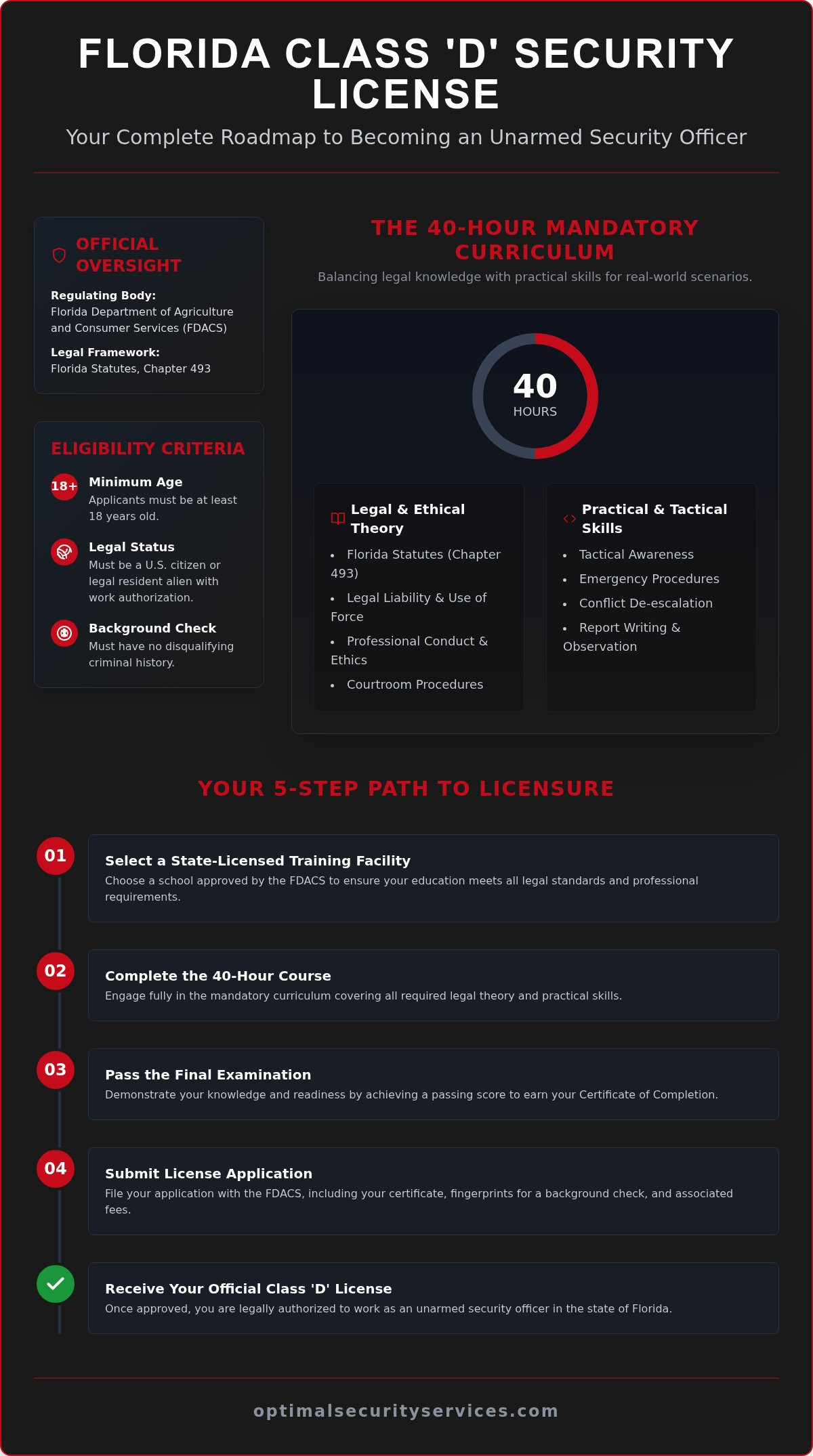
Your Step-by-Step Guide to Obtaining a Florida Class D Security License
The journey to professional licensure is a methodical process that requires precision and patience. It begins with your education and ends with the state's formal approval of your credentials. By following this structured roadmap, you'll ensure your application moves through the Florida Department of Agriculture and Consumer Services (FDACS) system without unnecessary friction. Accuracy at each stage is vital; it reflects the disciplined mindset required for the unarmed security officer training florida and the career that follows.
- Step 1: Enroll in and successfully complete the mandatory 40-hour unarmed security officer training florida curriculum.
- Step 2: Obtain your official certificate of completion from a state-licensed facility like Optimal Security.
- Step 3: Fill out the state application (Form FDACS-16007) and pay the required fees, which include a $45 application fee and $42 for fingerprint processing.
- Step 4: Submit your electronic fingerprints via a Livescan service for a thorough criminal history background check.
- Step 5: Provide a passport-quality photograph that meets state specifications for your physical license card.
If you're ready to take the first step in this professional journey, enroll in our security d license training program to secure your certificate of completion.
Navigating the Application Process
You have two primary paths for submission: the online digital portal or an in-person appointment at a FDACS regional office. Online submissions offer speed, but in-person appointments allow staff to review your documents for immediate errors. Common mistakes, such as incorrect fee amounts or incomplete history sections, often lead to lengthy delays. While you wait for your "hard card" to arrive in the mail, maintain a copy of your submitted application and certificate. For a deeper look at industry standards and preparation tips, see our Security License Training in Florida Guide.
Background Checks and Fingerprinting
The state uses the Livescan electronic fingerprinting process to conduct a modern, efficient background check. This system transmits your prints directly to the Florida Department of Law Enforcement and the FBI. It's important to understand that past criminal records don't always result in an automatic denial, but they do require full disclosure. Honesty during this stage is non-negotiable. The Division of Licensing reviews each case based on the nature of the offense and the time elapsed since the incident. This rigorous vetting process maintains the integrity of the profession and ensures that only the most dependable individuals are entrusted with public safety.
Beyond the Classroom: Launching a Professional Security Career
Earning your Class D license is the definitive start of a journey, not the destination. With approximately 140,000 active security guards as of 2024, Florida stands as the third-largest state for private security employment in the nation. This vast market creates a competitive environment where the quality of your initial unarmed security officer training florida becomes your primary differentiator. Top-tier firms aren't just looking for a license; they're searching for professionals who demonstrate a proactive mindset and a disciplined approach to public safety. Your performance during your first assignments will build the reputation that carries you through your career.
We believe that professional development is a continuous process. While the Class D license allows you to work in an unarmed capacity, many officers eventually choose to expand their capabilities by pursuing a Class G license for armed protection. This transition requires additional specialized instruction and a commitment to even higher safety standards. Regardless of your ultimate goals, we position ourselves as your steadfast partner, providing the educational foundation you need to adapt and excel as industry requirements evolve. Your success in the field is a reflection of the "quiet strength" you cultivate during your earliest days of instruction.
Job Opportunities in the Florida Market
Florida's diverse economic landscape offers a wide variety of environments for protection professionals. You might find yourself securing high-end residential complexes, managing loss prevention in luxury retail settings, or providing essential access control for corporate headquarters. High-traffic hubs like Miami demand a level of alertness and technical proficiency that only rigorous preparation can provide. For those targeting roles in the state's most active metropolitan markets, our guide on Professional Unarmed Security Training in Miami details the specific expectations and opportunities available to new graduates.
Professionalism and Career Growth
Maintaining your professional standing requires diligence beyond the job site. Your Class D license is valid for two years, and you must complete the renewal process and pay the $45 renewal fee on time to avoid a lapse in your authority. As you gain experience, you can leverage your training to move into supervisory positions or specialized protection roles. Professionalism means treating every shift with the same level of discipline you applied during your 40 hours of classroom instruction. If you're ready to build a career founded on reliability and expertise, contact Optimal Security today to begin your professional journey and secure your future in the security industry.
Securing Your Future in Florida's Private Security Sector
Your transition into the protection field begins with a commitment to excellence and a clear understanding of state mandates. Successfully completing the mandatory 40-hour unarmed security officer training florida requirement is the defining moment where your professional journey takes shape. By choosing a program that balances legal theory with practical tactical awareness, you prepare yourself to meet the rigorous standards of the Florida Department of Agriculture and Consumer Services with total confidence. Accuracy and discipline during this initial phase will dictate your long-term success and effectiveness in the industry.
Optimal Security stands as your steadfast partner throughout this process. As a state-licensed training facility, we offer expert instructors with real-world experience and comprehensive exam preparation to ensure you're fully prepared for the field. Don't leave your career foundation to chance; instead, choose a path built on reliability and quiet strength. Start Your Career: Enroll in Our Professional Security Training today. We're dedicated to your professional growth and look forward to seeing you excel in your new role with honor and diligence.
Frequently Asked Questions
How long does the unarmed security officer training take in Florida?
In Florida, the mandatory curriculum for a Class D license requires exactly 40 hours of instruction from a state-licensed facility. This time commitment is a non-negotiable legal requirement set by the Florida Department of Agriculture and Consumer Services (FDACS). Most students complete this training over a single week or across specific weekend blocks depending on the school's schedule. This ensures you receive the foundational knowledge necessary for professional protection work.
Can I take the Florida Class D security course online?
Online training options are becoming more prevalent in the Florida market, offering flexibility for those with busy schedules. However, many industry professionals recommend in-person instruction for the tactical and practical portions of the unarmed security officer training florida. Hands-on guidance for patrol techniques and emergency response provides a level of readiness that digital modules often struggle to replicate. Always verify that any online provider is a state-licensed DS school like Optimal Security.
What is the passing score for the Florida security license exam?
Students must achieve a passing score on a standardized final examination administered by their training facility. This exam covers legal theory, ethics, and emergency protocols learned throughout the 40-hour course. While specific thresholds can vary by institution, most state-licensed schools require a minimum score of at least 70% to 75% to demonstrate proficiency. Successful completion of this test is the final hurdle before you receive your official certificate of completion for the state.
Do I need a high school diploma to become a security guard in Florida?
You don't specifically need a high school diploma or GED to obtain a Class D security license in Florida. The state's primary eligibility requirements focus on your age, citizenship status, and background. You must be at least 18 years old and capable of reading, writing, and speaking English fluently. While a diploma isn't a legal requirement, many top-tier security firms prefer candidates with a basic educational foundation during their hiring process.
How much does it cost to get a security license in Florida in 2026?
The total initial cost for the state application in 2026 is approximately $97.75. This figure includes a $45 application fee, a $42 fingerprint processing fee, and a $10.75 fingerprint retention fee. It's important to remember that these are government fees paid to FDACS and don't include the tuition for your 40-hour training course. Budgeting for both the education and the state fees ensures a smooth transition into your new career.
What happens if I have a criminal record but want a security license?
A criminal record doesn't result in an automatic denial, but it does trigger a thorough review by the Division of Licensing. Certain disqualifying offenses, especially those involving violence or theft, can prevent you from obtaining a license. You must be honest during the application process and provide all requested documentation regarding past incidents. The state evaluates each applicant individually based on the nature of the crime and how much time has passed since the incident.
How long is the Florida Class D security license valid?
Your Florida Class D security license remains valid for two years from the date it's issued. To maintain your professional standing, you must submit a renewal application and pay a $45 renewal fee before the expiration date. The state typically sends out renewal notices well in advance. Staying proactive with your renewals prevents a lapse in your authority and ensures you can continue working without interruption in your professional protection career.
Can I work as a security guard while my application is being processed?
You cannot legally work as a security officer until you've received your physical license or a temporary permit from the state. Working without a valid license is a violation of Florida Statutes Chapter 493 and can lead to fines for both you and your employer. Once your unarmed security officer training florida is complete and your application is submitted, you must wait for the FDACS to finalize your background check and issue your credentials.


