
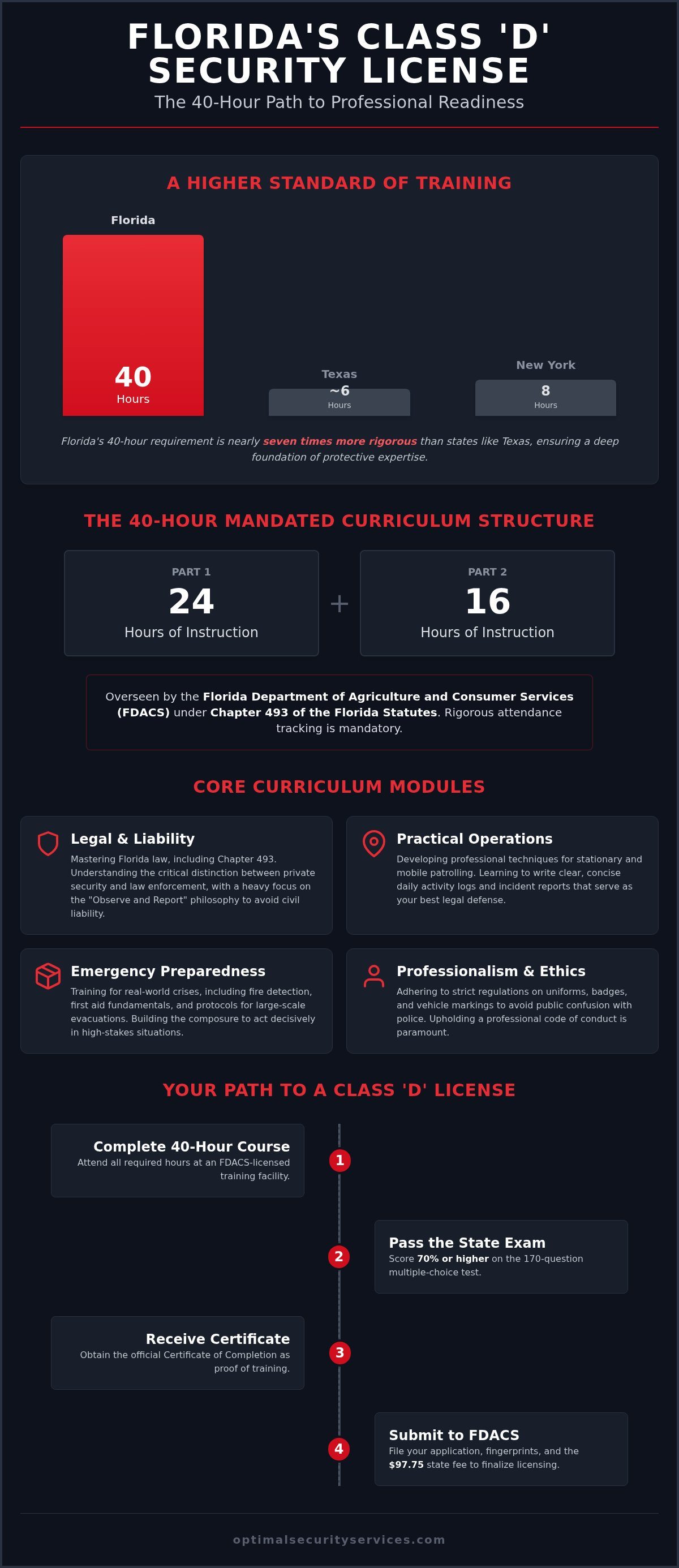
Did you know that Florida's 40-hour training requirement for unarmed guards is nearly seven times more rigorous than the standards in Texas or New York? This depth is not meant to be a barrier. It is designed to transform you into a disciplined professional capable of handling high-stakes environments with composure. When you begin your journey toward a Class D license, the security training curriculum florida mandates ensures you aren't just memorizing rules but are building a foundation of protective expertise.
It is natural to feel a sense of anxiety about the mandatory hours or the final exam, especially if you're wondering whether the training is purely academic or truly practical. Whether you are concerned about navigating complex legal statutes or you are simply looking for the most efficient way to prepare for the state exam, we are here to provide clarity. This guide provides a comprehensive breakdown of the 40-hour course, covering everything from legal liabilities and emergency procedures to professional ethics. You will gain a clear roadmap of the subjects you must master to pass your exam and begin your career with confidence.
Key Takeaways
- Understand the 40-hour mandate governed by the FDACS and why this intensive state requirement is essential for securing your Class D license.
- Gain clarity on the legal boundaries of private security, specifically the critical distinction between observing and reporting versus detaining and arresting under Florida law.
- Learn the professional techniques of stationary and mobile patrolling that transform a simple watch into a proactive security measure.
- Discover how the specialized security training curriculum florida requires prepares you for real-world emergencies, including fire detection and large-scale evacuation protocols.
- Prepare for the Florida Class D license exam with confidence by focusing on the specific academic and practical skills that employers in South Florida value most.
Florida State-Mandated Security Training Requirements
In Florida, the private Security Guard Profession is strictly regulated to ensure public safety and professional integrity. With approximately 140,000 active security guards as of 2024, Florida is the third-largest state for private security employment in the country. The Florida Department of Agriculture and Consumer Services (FDACS), specifically the Division of Licensing, maintains oversight of all these personnel. This regulatory framework is established under Chapter 493 of the Florida Statutes, which mandates that any individual seeking to work as an unarmed security officer must complete a state-approved 40-hour training program. The Class D security training curriculum florida requires serves as the foundational educational requirement for all unarmed guards entering the industry. It's a non-negotiable legal hurdle that ensures every officer possesses the same baseline of essential knowledge before stepping onto a job site.
The 40-Hour Course Structure
The security training curriculum florida mandates is typically divided into two distinct segments to facilitate comprehensive learning. Part 1 consists of 24 hours of instruction, while Part 2 covers the remaining 16 hours. This structure allows students to digest complex legal and operational concepts over several days rather than rushing through critical material. State law requires rigorous attendance tracking; students must sign state-mandated logbooks for every hour of instruction received. Choosing an FDACS-licensed training facility is critical, as hours completed at an unlicensed school won't be recognized by the state. This oversight prevents shortcuts and maintains a high standard of readiness across the board. Compliance is mandatory.
Certification and the Final Examination
Once the 40 hours of instruction are complete, students must face the final challenge: the state-mandated exam. This comprehensive test usually consists of 170 multiple-choice questions designed to evaluate your grasp of the entire curriculum. A passing score of 70% or higher is required to demonstrate competency. The curriculum is specifically engineered to prepare you for this exam, covering topics ranging from legal liability to emergency response protocols. Preparation is key. After successfully passing the test, you'll receive a certificate of completion. This document is the primary evidence needed for your Class D license application. You'll then submit your fingerprints and the required $97.75 fee to the FDACS to finalize your licensing process and begin your professional career.
Core Legal and Liability Modules: Understanding Florida Law
Understanding the legal boundaries of your role is the most critical component of the security training curriculum florida mandates. Unlike law enforcement officers, private security guards derive their authority primarily from the property owner's rights and specific state statutes. This distinction is vital; overstepping your authority can lead to severe legal consequences for both you and your employer. The curriculum emphasizes the "Observe and Report" philosophy, which serves as the industry standard for unarmed personnel. While you are trained to be a deterrent, you must understand that your power to detain is extremely limited. Misinterpreting this thin line often results in claims of false imprisonment or assault. Mastering these legal nuances is essential for professional survival.
Civil liability is another heavy focus during your training. In a litigious environment, a single mistake can result in a costly lawsuit. You will learn how to identify high-risk situations and apply the proper protocols to mitigate risk. This includes understanding the legal definitions of negligence and how a well-maintained daily activity log serves as your best defense in court. Protecting yourself means protecting your career. For those seeking a deep dive into these topics, the Security D License Training Curriculum provides the necessary framework to operate safely within the law.
Florida Statute 493 and Your License
Chapter 493 of the Florida Statutes dictates every aspect of your professional appearance and behavior. This includes strict regulations on how your uniform must look, the specific wording on your badges, and even the way your patrol vehicle is marked. These rules exist to prevent the public from confusing private security with public police forces. You can review the full scope of these regulations through Florida's Official Security License Requirements. Failing to adhere to these standards doesn't just result in a reprimand. It can lead to the immediate suspension of your license or heavy fines from the state.
Use of Force and Liability Limitations
In Florida, the "Use of Force" continuum is a central pillar of the security training curriculum florida students must master. You will learn how to de-escalate situations using verbal commands before ever considering physical intervention. While Florida's Chapter 776, the "Stand Your Ground" law, provides a legal framework for self-defense, its application in a professional security context is highly specific. You are expected to use only the minimum force necessary to neutralize a threat. Every incident involving physical contact must be documented with meticulous detail in a formal report. This documentation is your primary defense against civil liability. If you are ready to master these professional standards, consider how our structured approach can help you succeed at Optimal Security.
Practical Operations: Patrol Techniques and Report Writing
Moving from legal theory into the field, the security training curriculum florida mandates focuses heavily on the tactical application of your skills. Whether you are assigned to a stationary post at a high-rise lobby or performing mobile patrols across a sprawling industrial complex, the curriculum provides a methodical framework for your daily operations. You will learn to differentiate between foot, bicycle, and vehicle patrols, understanding that each method offers unique advantages for visibility and incident deterrence. A core component of this training is the art of observation. Instructors teach you to identify "out of place" indicators, such as unsecured entry points or individuals displaying pre-incident behavioral cues, which allow you to mitigate threats before they escalate. Consistent with Florida's Official Security License Requirements, these practical modules ensure you are prepared for the physical realities of the job.
Access control is another pillar of modern security operations. You will be trained to manage high-security areas by verifying credentials, logging visitors, and maintaining the integrity of perimeter gates. In these roles, you act as the first line of defense for Florida's critical infrastructure and private communities. Beyond physical presence, your ability to communicate your findings is paramount. Report writing is the primary way a Florida security officer demonstrates value to their client. It transforms your observations into a professional record that can be used for insurance purposes, management decisions, or legal proceedings.
The Science of Professional Report Writing
Modern security environments in 2026 have shifted away from traditional paper logs toward sophisticated digital reporting systems. The Security D License Training Curriculum prepares you for this transition by emphasizing the "Five Ws": Who, What, When, Where, and Why. Your reports must be factual, objective, and free of personal opinion, as they frequently serve as legal evidence in Florida courts. Mastering this skill ensures that your actions are documented with the precision required to protect both the client's interests and your professional reputation.
Observation and Incident Detection
Developing a "security mindset" is essential for navigating high-traffic Florida venues like shopping malls or event stadiums. You'll learn to identify suspicious behavior without relying on profiling, focusing instead on objective actions and environmental anomalies. Effective communication protocols are also covered, including the proper use of two-way radios and industry-standard codes. This ensures that when an incident is detected, you can coordinate a response with your team and local emergency services with professional calm and clarity.
Emergency Preparedness and Life Safety Fundamentals
Security officers are often the first on the scene during a crisis, making emergency preparedness a cornerstone of their professional identity. The security training curriculum florida mandates includes a deep dive into fire safety and prevention. You'll learn the "Fire Triangle," which explains that a fire requires heat, fuel, and oxygen to survive. By understanding these elements, you can identify hazards before they ignite. You will also study the specific types of fire extinguishers, such as Class A, B, and C, ensuring you can match the right tool to the specific threat. This is especially vital in large-scale Florida facilities like resorts or stadiums where evacuation procedures must be executed with precision. For a broader look at the path to your career, see our Security License Training in Florida guide.
Beyond fire safety, the curriculum focuses on crisis intervention and professional de-escalation. You'll develop the skills to manage volatile situations without the need for physical force. This involves recognizing the signs of emotional distress or aggression and using verbal techniques to calm an individual. You will learn to use active listening and tactical communication to redirect energy away from violence. The goal is always to resolve a conflict professionally, maintaining the safety of everyone on the property while minimizing the risk of liability for your employer.
First Aid, CPR, and AED Awareness
While security officers aren't medical professionals, they act as a critical bridge until EMS arrives. The curriculum ensures you're prepared to administer basic life-saving techniques, including CPR and the use of an Automated External Defibrillator (AED). You'll practice identifying the signs of a heart attack or stroke, which are common medical emergencies in high-traffic commercial zones. Florida's Good Samaritan Law provides essential legal protection for security officers who provide emergency assistance in good faith. You'll learn the boundaries of this protection and the specific protocols for managing medical emergencies without overstepping your training.
Active Shooter and Terrorist Awareness
Modern threats require modern training. The current security training curriculum florida includes updated modules on active shooter and terrorist awareness to address high-risk environments. You'll learn to identify "soft targets" and recognize pre-attack indicators like suspicious surveillance or unauthorized photography of security systems. As an unarmed officer, your role during an active threat is centered on notification, evacuation, and providing accurate information to law enforcement. This training moves beyond the textbook to provide actionable strategies for real-world survival. To see how our instructors prepare you for these challenges, explore our security training curriculum today.
Why Optimal Security’s Curriculum Prepares You for a Career
Choosing where to complete your security training curriculum florida is a decision that shapes your entire professional trajectory. At Optimal Security School, we believe that state-mandated hours should be more than just a legal hurdle. Our program is built on the philosophy that true competence comes from a blend of academic rigor and real-world application. Our instructors bring decades of field experience from across the state, ensuring that the scenarios you study are grounded in actual incidents they've managed. This practical approach bridges the gap between the textbook and the high-stakes environments you'll face on your first day of duty. You aren't just learning to pass a test; you're learning to lead with confidence.
We recognize that the South Florida market demands a specific set of skills that general courses often overlook. Our curriculum is fine-tuned to reflect the needs of high-end commercial districts and complex urban environments. Beyond the classroom, we're committed to your long-term success. We offer dedicated job placement guidance and career counseling to help our graduates navigate the transition into the workforce. This holistic support is why many consider us the Leading Security Officer Training School in Florida. We take pride in seeing our students move from the classroom into rewarding roles with some of the state's most respected agencies.
The Optimal Advantage in Miami
Our training is specifically tailored to the unique demands of the Miami metropolitan area. Whether you're securing a luxury residential complex in Brickell or managing access control for a premier retail destination, our modules emphasize professional authority balanced with a service-oriented mindset. We provide a welcoming environment for those new to the industry, guiding you through the complexities of the profession with patience and precision. Our goal is to instill a sense of quiet strength in every student, preparing you to be a protector who is both highly skilled and deeply committed to client satisfaction. This bespoke approach ensures our graduates are the most sought-after professionals in the region.
Enrollment and Your Path Forward
Taking the first step toward your new career is straightforward. To register for our next Class D training session, visit our security training curriculum page to view upcoming dates and availability. Before your first day, ensure you have your preparation checklist ready: bring a valid state ID, a notebook for detailed observations, and a professional attitude ready for disciplined learning. We've streamlined the enrollment process to get you started as quickly as possible. Your professional journey starts with the right foundation and a commitment to excellence. Start your professional journey today and join a community of protectors dedicated to the safety of our Florida communities.
Launch Your Career in Private Security
Mastering the security training curriculum florida requires is more than a regulatory necessity; it's the foundation of a disciplined professional life. By understanding the legal boundaries of Chapter 493 and developing practical field skills in observation and emergency response, you position yourself as a reliable protector. Whether you're navigating complex liability statutes or perfecting your patrol techniques, the knowledge you've gained ensures you're ready for the field. Your commitment to this training reflects the serious nature of the industry.
As an FDACS Licensed Training Center, we're dedicated to your success. Our expert instructors bring real field experience to every lesson, contributing to our high student pass rates and the professional readiness of our graduates. You don't have to navigate this path alone. We provide the structure and expertise needed to transform your interest into a career. Take the next step toward your Class D license today. View Our Upcoming Security Training Schedule and start your journey with a partner committed to your professional excellence. We look forward to helping you achieve your goals.
Frequently Asked Questions
What is the standard security training curriculum in Florida?
The standard security training curriculum florida requires focuses on legal authority, patrol strategies, and emergency response. Students dive deep into the professional standards necessary for high-stakes environments. This includes mastering the "Observe and Report" philosophy and understanding the boundaries of private security power. The goal is to build a foundation of protective expertise through state-approved modules that ensure every officer meets the same rigorous baseline before entering the workforce.
How many hours of training are required for a Florida Class D license?
A minimum of 40 hours of professional training is required to obtain a Florida Class D license. This instruction must come from a facility licensed by the Florida Department of Agriculture and Consumer Services (FDACS). The training is typically split into two parts, covering 24 and 16 hours respectively. Every hour is documented in state-mandated logbooks to ensure compliance with Chapter 493, providing a comprehensive education for all aspiring unarmed officers.
Does the Florida security curriculum include firearms training?
The mandatory 40-hour Class D curriculum doesn't include firearms training, as it's specifically for unarmed security officers. If you wish to work as an armed guard, you must complete an additional 28 hours of range and classroom instruction for the Class G Statewide Firearm License. Florida maintains a two-tier system where the Class D license is the prerequisite for all security work, regardless of whether you eventually carry a firearm.
What happens if I fail the security training final exam?
If you don't achieve a passing score on the final exam, you typically have the opportunity to review the material and retake the test. Most state-approved schools, including Optimal Security, focus on student success by providing thorough remediation. The exam consists of 170 multiple-choice questions, and the curriculum is specifically designed to prepare you for this challenge. Our instructors ensure you're ready to meet the 70% passing threshold with confidence.
Can I take the Florida security training curriculum online in 2026?
Yes, Florida allows the 40-hour Class D training to be conducted via live online instruction as of 2026. This makes the security training curriculum florida mandates more accessible for those with busy schedules. It's critical to remember that these sessions must be led by a live instructor in real-time to meet FDACS requirements. However, any subsequent Class G firearms training still requires in-person participation for the mandatory range component.
Is the curriculum the same for every security school in Florida?
While the core topics are standardized by the FDACS to meet legal requirements, the quality of instruction varies between schools. Optimal Security enhances the basic curriculum with real-world insights from experienced field professionals. We tailor our training to the specific needs of modern security environments, ensuring our students aren't just memorizing facts but are developing the practical problem-solving skills needed to excel in diverse professional settings across the state.
Does the training cover Florida Chapter 493 laws?
Yes, Chapter 493 of the Florida Statutes is the governing framework for the entire curriculum. This legal module covers everything from uniform and badge restrictions to the specific authority of a private security officer. Understanding these laws is essential for protecting yourself and your employer from civil liability. The training ensures you can navigate complex legal situations, such as use-of-force incidents, while remaining in full compliance with Florida's professional standards.
Will this curriculum prepare me for a job in Miami security?
Absolutely. Our curriculum is specifically fine-tuned for the unique demands of the Miami and South Florida security markets. We focus on high-end residential, luxury retail, and the hospitality sectors common in the region. By training with instructors who understand the local landscape, you gain a competitive edge. We prepare you to handle the specific challenges of urban security with the professional authority and composure that Miami's top employers expect.


