
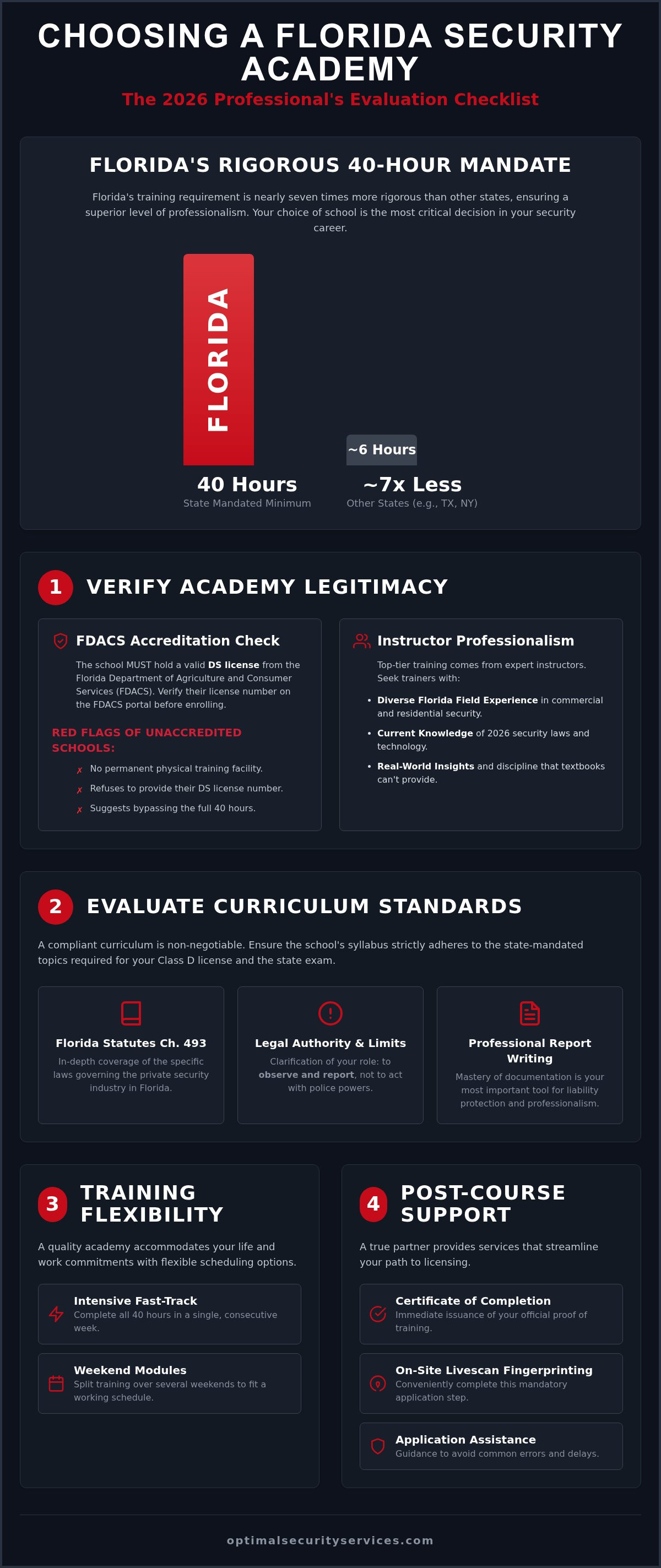
Florida's 40-hour training mandate for unarmed guards is nearly seven times more rigorous than the standards found in states like Texas or New York. This high bar ensures a high level of modern professionalism, yet it also means that selecting the right security school is the most significant decision you'll make as you enter the industry. It's completely normal to feel a sense of hesitation about whether a program is fully accredited or if it will actually prepare you for the rigors of the state exam.
You want a training partner who treats your career with the same gravity and discipline that you bring to the job. Whether you're concerned about the technical curriculum or the specifics of the application process, we recognize the confusion that often surrounds state requirements and the legitimate concern of investing in a course that doesn't meet FDACS standards. This article provides a comprehensive 2026 evaluation checklist designed to help you vet any academy with absolute confidence. We'll walk through the essential markers of quality, from instructor expertise to licensing support, so you can move forward with a sense of protective calm and readiness.
Key Takeaways
- Learn how to verify a provider's official DS license to ensure your 40-hour training investment is recognized by the Florida Department of Agriculture and Consumer Services.
- Understand the essential curriculum standards mandated by Florida Statutes Chapter 493 to ensure you are fully prepared for the state exam and your professional duties.
- Evaluate any potential security school based on its scheduling flexibility and its ability to offer hybrid learning models that accommodate your current work commitments.
- Identify the critical post-course support services, such as on-site Livescan fingerprinting and application assistance, that streamline your path to a Class D license.
- Discover the benefits of choosing a training partner that provides a solution-focused approach and steady guidance throughout the entire licensing process.
Verifying State Credentials and Academy Legitimacy
Before you commit your time or tuition to a security school, you must ensure the institution is legally authorized to provide the training you need. In Florida, the private Security Guard Profession is strictly governed by the Florida Department of Agriculture and Consumer Services (FDACS) under Chapter 493 of the Florida Statutes. If a school doesn't hold a valid DS license, the hours you spend in the classroom won't count toward your Class D license application. This verification step protects your investment and ensures your path to employment remains clear.
The FDACS Accreditation Check
A licensed security school is the only legal pathway to earning your mandated training hours. You can easily verify any training facility by visiting the FDACS Division of Licensing portal and searching for their active license status. Look for a current DS license number prominently displayed on their website or marketing materials. Red flags of unaccredited operations often include a lack of a permanent physical training facility or a refusal to provide a license number when asked. If a school suggests you can bypass the state-mandated 40 hours of instruction, they're likely non-compliant and could jeopardize your future career.
Instructor Professional Background
The quality of your training depends heavily on the expertise of your instructors. You should seek out trainers who possess diverse field experience in Florida, ranging from high-stakes commercial environments to complex residential security. These professionals offer a level of specialized training that theoretical textbooks cannot match. It's vital that your instructors remain current with 2026 Florida security laws and technological integrations. Their "quiet strength" and real-world insights provide the discipline and rigor required for modern professionalism. Ask about their specific background in the industry before enrolling to ensure they can provide the bespoke guidance you deserve.
Beyond the classroom hours, a legitimate academy must provide a formal Certificate of Completion immediately upon graduation. This document serves as your official proof of training when you submit your application to the state. It should clearly state the school's name, license number, and the total hours completed. A steadfast partner in your licensing journey will be proactive and organized, ensuring all your paperwork is in order so you can approach the state exam with a sense of protective calm and readiness. Demand precision in your training; your career as a professional protector depends on it.
Evaluating the Class D License Curriculum Standards
Florida maintains some of the most rigorous training standards in the country for private security officers. While other states might only require a few hours of orientation, the Sunshine State demands a comprehensive foundation that prepares you for real-world challenges. When you evaluate a potential security school, your first priority is to verify that their syllabus adheres strictly to the state-mandated 40-hour curriculum. This isn't a suggestion; it's a legal requirement for your Class D license.
The 40-Hour Mandatory Requirement
The state-mandated 40 hours of instruction are usually delivered over a consecutive five-day period or split into manageable weekend modules. Some academies offer intensive fast-track programs that condense the material into a single week, while others provide standard schedules that span several weekends to accommodate working students. You must be present for every single hour of instruction. Skipping even a small portion of the course can lead to a license denial when the FDACS reviews your application. A dedicated training center will maintain meticulous attendance records to protect your eligibility. If you're looking for a partner that respects these standards, you can review our training options to see how we structure our curriculum for student success.
Legal and Professional Responsibilities
A high-quality curriculum must ground you in the specific legalities of Florida Statutes Chapter 493. This includes a deep dive into the limits of your arrest authority. Many new officers mistakenly believe they have the same powers as police officers. They don't. A professional security school will clarify that your role is primarily to observe and report. Mastery of report writing and documentation is equally vital. In the modern industry, your written record is your most important tool for liability protection and professional communication. Ethical conduct and modern professionalism are the cornerstones of the 2026 security landscape. Precision matters.
Beyond legal theory, ensure the program incorporates practical modules on emergency procedures and first aid basics. The ability to remain calm and provide initial assistance during a medical crisis is a hallmark of "quiet strength." Additionally, look for a syllabus that addresses de-escalation techniques and technological integration. Modern security work involves more than just physical presence. It requires the ability to use digital reporting tools and manage conflict through verbal communication. You can find detailed information on these requirements through the official Florida Security Guard Licensing resource to confirm what the state expects from your education. Choose a school that views these standards as the minimum, not the ceiling, for your professional development.
Comparing Training Formats: Flexibility and Scheduling
Finding a security school that respects your current professional and personal commitments is essential for a smooth transition into the industry. While the 40-hour state requirement is non-negotiable, the way you complete those hours can vary significantly between institutions. You should determine whether a school offers weekend or evening classes, as these schedules are designed specifically for working students who cannot attend a standard weekday program. A professional academy understands that its students are often balancing multiple responsibilities and provides a steady, methodical pace that ensures success without burnout. Precision in scheduling is the first sign of a well-organized training partner.
In-Person vs. Hybrid Training
In 2026, the choice between traditional in-person instruction at a security school and hybrid learning options has become a primary factor for many candidates. Hybrid models allow you to complete theory modules online before attending the training center for in-person practicals. This format offers incredible flexibility for busy professionals, yet face-to-face networking with experienced instructors remains invaluable for your long-term career. Practical drills are essential for building the confidence you'll need before your first shift. Whether you prefer the structure of a classroom or the adaptability of a digital portal, your training must remain rigorous and focused on modern professionalism. Hands-on experience is simply irreplaceable.
Location and Accessibility
The proximity of your chosen security officer training school florida to major hubs like Miami can drastically impact your overall experience. Consider the ease of your daily commute and the availability of parking for intensive multi-day courses. Local schools often maintain stronger ties to regional employers, providing a direct link to the local job market that national online-only programs cannot match. Beyond the commute, evaluate the classroom environment itself. It should be a professional space that is conducive to learning, reflecting the gravity of the protective work you are preparing to undertake. Visit the facility if possible. A dedicated training center projects a sense of organized strength and readiness from the moment you walk through the door. Evaluate the classroom environment with precision.
Assessing Post-Course Support and Licensing Assistance
A premier security school recognizes that your journey doesn't end the moment you finish your final hour of instruction. The transition from student to licensed professional involves a series of administrative steps that require precision and attention to detail. When you evaluate potential academies, ask if they provide on-site Livescan fingerprinting services. This integrated approach ensures your background check is handled correctly and saves you the frustration of coordinating with outside vendors. A steadfast training partner acts as a guide, ensuring every requirement is met with methodical accuracy and a sense of protective calm.
Navigating the Application Maze
The Florida Department of Agriculture and Consumer Services (FDACS) application process is rigorous. Even minor clerical errors can lead to significant processing delays or a returned application. Many candidates struggle with the specific documentation requirements or the nuances of the online portal. High-quality unarmed security training miami providers often include dedicated sessions to help you fill out your paperwork correctly the first time. Having an expert review your application before submission provides peace of mind, knowing that your path to employment won't be blocked by avoidable mistakes. This solution-focused support is what separates a mere classroom from a true career partner.
Career Placement and Networking
Your chosen security school should be a gateway to the industry, not just a place to earn a certificate. Inquire about their job placement assistance and whether they maintain active connections with local employers. Schools that take pride in their reputation often have a network of security firms eager to hire their graduates because they trust the quality of the training provided. Additionally, check if the school offers exam prep materials or practice tests to bolster your confidence before the state exam. A dedicated training center will also offer a clear path for your future growth, helping you understand the long-term trajectory of the industry. This includes guidance on maintaining your license and eventually pursuing advanced certifications. This proactive approach to your career development reflects a commitment to traditional service values blended with a modern, forward-thinking outlook. If you're ready to start your career with a partner that supports you at every turn, contact us today for enrollment details.
Why Optimal Security is the Premier Choice for Florida Students
Optimal Security School stands as a steadfast partner for those entering the private security profession. Selecting a security school is a decision that impacts your entire career trajectory, and we approach this responsibility with the discipline and rigor it deserves. Our philosophy is built on quiet strength, a combination of authoritative expertise and a dedicated commitment to our students' success. Whether you're a newcomer to the industry or a professional seeking to formalize your experience, we provide a protective calm that allows you to focus on mastering your craft. We don't just provide a classroom; we offer a pathway to a professional identity.
We've developed a solution-focused approach to security license training florida that removes the anxiety often associated with state requirements. Our curriculum doesn't simply meet the 2026 state standards; it exceeds them by integrating modern technological tools and advanced de-escalation strategies. We believe that a professional protector must be as skilled with digital reporting systems as they are with situational awareness. This forward-thinking outlook ensures our graduates are prepared for the specific requirements of high-level commercial and residential clients from day one. Precision in training leads to precision in the field.
The Optimal Security Difference
The hallmark of our program is the way we treat every student as a future partner in safety. We don't view our courses as a detached service. Instead, we offer bespoke guidance that adapts to your specific career goals. Our instructors bring documented field experience and modern professionalism to every session, providing real-world insights that bridge the gap between theory and practice. Successfully licensed Florida officers often cite our organized and proactive nature as the key to their confidence during the state exam. We take great pride in these relationships, valuing the long-term success of our alumni as a reflection of our own dedication and specialized expertise.
Start Your Career Today
Beginning your journey with us is a methodical and steady process designed for your convenience. We offer an easy enrollment process for our upcoming Class D sessions, with schedules that respect your existing commitments. From your initial inquiry to the moment you step onto your first job site, we remain your dedicated guide. If you have questions about the licensing journey or need personalized career guidance, our team is prepared to assist you with precision and politeness. Join the next class at Optimal Security. Take the first step toward a rewarding career by engaging with a team that values honor, diligence, and your total satisfaction. Contact us now to secure your seat in our next session.
Secure Your Professional Future Today
Selecting a security school is the most significant step toward establishing a career characterized by discipline and modern professionalism. You now have the essential tools to evaluate any training facility based on its FDACS credentials, curriculum rigor, and the quality of its instructors. Remember that your choice determines not just your license eligibility, but also your readiness to protect and serve with absolute confidence. A premier institution acts as more than just a classroom; it serves as a dedicated partner throughout your entire licensing journey.
As an FDACS licensed training facility, we provide expert instructors with real-world experience and comprehensive licensing application support to ensure your success. We invite you to begin this journey with a team that values precision, reliability, and protective calm. Enroll in Florida’s Leading Security School Today and take the first step toward your new career. We look forward to supporting your growth as a skilled protector and a trusted professional in the Florida security landscape. Your path to excellence starts here.
Frequently Asked Questions
What is the difference between a security school and a security agency?
A security school is an educational institution licensed to provide the state-mandated 40-hour curriculum, whereas a security agency is a business that employs licensed guards to provide protective services to clients. You attend a school to earn your training certificate, but you work for an agency. Schools focus on your professional development and licensing readiness, whereas agencies focus on site security, patrol, and client safety operations.
Can I complete my Florida security school training entirely online?
Yes, you can complete your Class D training through an online security school as long as the provider uses a secure website that verifies your identity and attendance. Florida law permits this flexibility for students who cannot attend a physical classroom. However, you must ensure the digital program is fully accredited by the FDACS to receive valid hours. Many students prefer hybrid options that combine online theory with in-person practical drills.
How long does it take to finish a standard security school program?
A standard program takes exactly 40 hours of instructional time to meet Florida's legal requirements for an unarmed guard. Most schools structure this as a five-day intensive course with eight hours of classroom time each day. Some facilities offer weekend-only modules to accommodate those currently working full-time. Regardless of the schedule, you must complete the full 40-hour syllabus before you receive your official certificate of completion for the state.
Do Florida security schools provide the actual Class D license?
No, the school provides the mandatory training and the certificate of completion, but the FDACS Division of Licensing is the only body that issues the actual license. Your school acts as a guide through the application process, helping you compile necessary documents and fingerprints. Once your training is finished, you'll submit your application to the state for final processing, which typically takes between 10 and 30 days.
What should I bring to my first day at a security school?
You should bring a valid government-issued photo ID, such as a Florida driver's license or passport, to verify your identity. It's also professional to bring materials for note-taking, including a dedicated notebook and pens, to document legal statutes and emergency procedures. Some academies suggest wearing business casual attire to reflect the discipline of the industry. If the security school offers on-site application assistance, bring the required state fees and your work authorization documents.
Is there a background check required before enrolling in security school?
Most schools don't require a background check for enrollment, but the state requires a comprehensive criminal history check before issuing your license. This process involves submitting digital fingerprints through an FDLE-approved Live Scan provider. If you have a history of disqualifying convictions or mental instability, the FDACS will deny your application even if you've finished school. It's best to review the eligibility requirements on the official state portal before you pay for tuition.
How much does it cost to attend a security school in Florida?
The total cost for entering the profession includes several separate expenses such as tuition, the non-refundable FDACS application fee, and fingerprinting costs. While tuition rates vary between training centers, the state application fee is currently $45 and fingerprinting typically ranges between $42 and $53. You should consider the total investment, including any additional materials or job placement services, as you compare different academies. Always ask for a clear breakdown of what's included in your enrollment.
What happens if I fail the exam at my security school?
If you fail the final exam at your security school, you'll typically be given the opportunity to retake the test after additional review. Most professional academies are dedicated to your success and will provide extra guidance or study materials to help you master the curriculum. The goal is to ensure you possess the quiet strength and technical knowledge required for the field. Be sure to ask about the school's specific retake policy and any associated fees before you enroll.


