
With the private security sector projected to expand by over $56 billion through 2026, there's never been a more strategic time to enter this protective profession. You likely recognize that a career in safety offers more than just a paycheck; it provides a sense of purpose and stability in an evolving world. However, the path to getting certified often feels cluttered with regulatory hurdles and complex state mandates. Finding a reputable florida security guard license course is the first step toward transforming that ambition into a professional reality.
We understand that the 40-hour training requirement can seem daunting, especially when combined with anxieties about the final exam or background check eligibility. This guide is designed to replace that uncertainty with a clear, disciplined roadmap to your Class D certification. You'll master the essential curriculum, navigate the FDACS application process with confidence, and learn exactly what's required to secure your license in 2026. We'll walk through the specific training modules, current state fees, and the transition from student to a high-quality security professional. Let's begin your journey toward a career defined by honor and readiness.
Key Takeaways
- Understand the legal framework of Chapter 493 Florida Statutes and why the state-mandated training is the essential foundation of your professional career.
- Explore the comprehensive curriculum of the florida security guard license course to prepare for both the final examination and real-world field scenarios.
- Evaluate the advantages of disciplined in-person instruction versus flexible online training to select the most effective learning environment for your schedule.
- Navigate the FDACS application process with a clear roadmap for submitting your electronic fingerprints and certificate of completion without delays.
- Identify how specialized training at Optimal Security School enhances your professional readiness and positions you for immediate success in the Florida security market.
Understanding the Florida Class D Security License Mandate
The legal landscape of private protection in Florida is governed by strict standards to ensure public safety and professional integrity. Under Chapter 493 of the Florida Statutes, any individual performing the duties of a security guard must hold a valid state-issued license. This legal mandate applies to anyone working for a licensed agency, whether they're monitoring property, protecting people, or providing general oversight. You can't legally work in this sector without completing a florida security guard license course at a state-approved school. Professional certification isn't just a regulatory hurdle; it establishes a baseline of competence that protects the officer, the client, and the public alike.
Florida distinguishes between unarmed and armed roles through its specific licensing structure. The Class D license is the foundational requirement for all unarmed officers. If you eventually intend to carry a firearm on duty, you'll need to secure a Class G license in addition to your Class D. However, the Class D remains the essential first step for entry into the profession. It provides the legal authority necessary to perform security functions and ensures that every officer on the street has received standardized instruction in safety and law.
Basic Eligibility Requirements for 2026
To begin your journey toward certification, you must meet specific state-mandated criteria. For the 2026 licensing cycle, applicants must be at least 18 years old to qualify for the Class D license. You're also required to be a citizen or legal resident alien of the United States. Your criminal history plays a vital role in the approval process. While minor infractions don't always disqualify you, the state conducts a thorough background check through electronic fingerprints. Felonies or crimes involving moral turpitude will likely lead to an application denial. It's a rigorous process designed to maintain the industry's high standards of trust and dependability.
The Role of the FDACS in Your Licensing
The Florida Department of Agriculture and Consumer Services (FDACS), specifically the Division of Licensing, serves as the regulatory body for the entire industry. They oversee the issuance of licenses, the approval of instructors, and the enforcement of Chapter 493. It's critical to attend a licensed training facility because the state will only recognize certificates from authorized schools. The Class D license serves as the primary credential for unarmed security officers in Florida. Choosing a reputable florida security guard license course ensures your training aligns with current state laws and prepares you for immediate employment. This structured oversight provides the quiet strength and reliability that Florida businesses depend on for their daily protection needs.
The 40-Hour Security Guard Course Curriculum
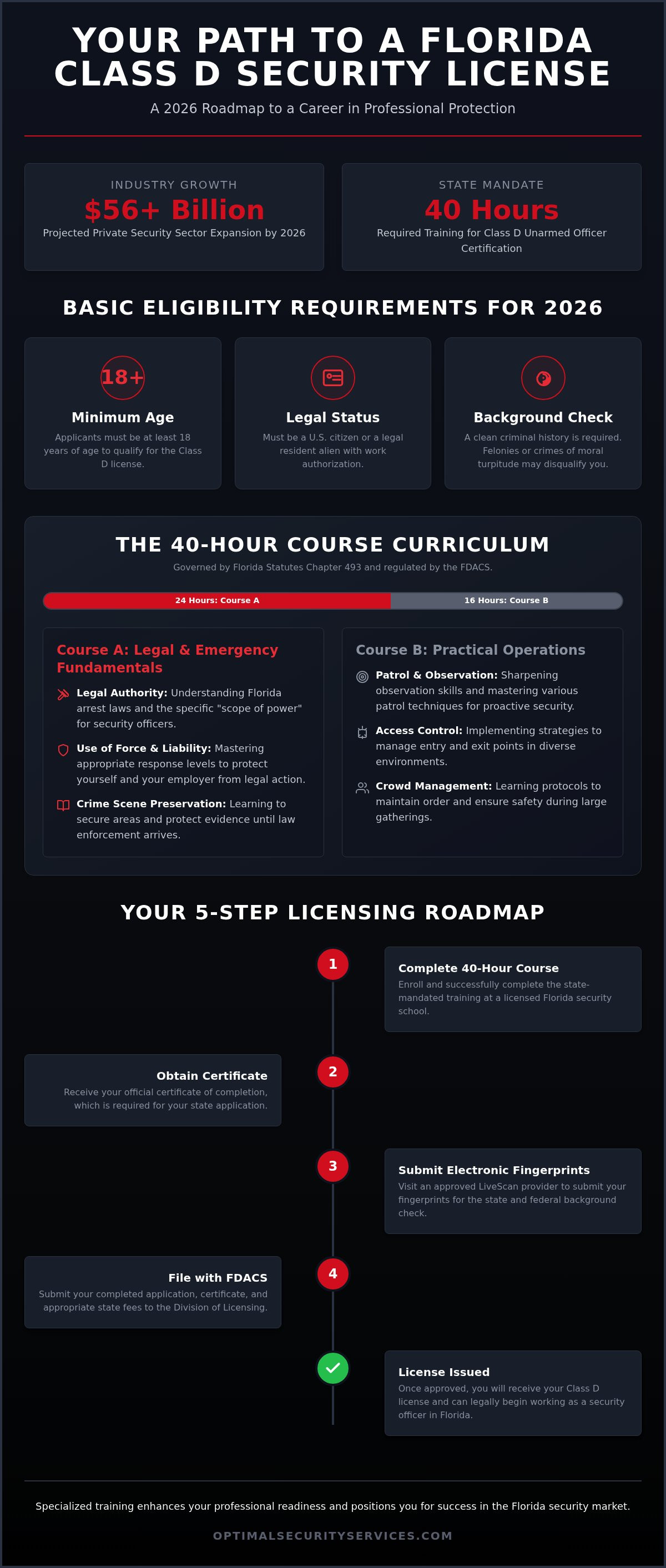
The transition from civilian to professional officer requires a deep dive into the state's rigorous instructional standards. Completing a florida security guard license course isn't just about sitting in a classroom; it's about acquiring the specialized skills needed to handle high-pressure situations with a composed, solution-focused mindset. The 40-hour curriculum is typically divided into two segments: Course A, which focuses on 24 hours of legal and emergency fundamentals, and Course B, which provides 16 hours of practical operational training. This structure ensures you're prepared for the final exam and the daily challenges of the job.
Legal and Liability Training
A significant portion of your training focuses on the legal authority of a security officer. You'll learn the boundaries of Florida arrest laws and the specific "scope of power" that distinguishes you from law enforcement. Understanding the appropriate use of force is vital to protecting yourself and your employer from liability. Instructors also emphasize crime scene preservation. You'll learn how to secure an area and protect evidence until the authorities arrive; a skill that's essential for maintaining the integrity of an investigation. Mastering these legal nuances is a core part of any reputable florida security guard license course.
Operational Security Procedures
Operational training provides the tactical tools for daily success. You'll master various patrol techniques and sharpen your observation skills to detect anomalies before they escalate. The course covers access control strategies and crowd management protocols, ensuring you can maintain order in diverse environments like retail centers or construction sites. Specialized modules on terrorism awareness and fire safety protocols prepare you to act as a reliable first responder during emergencies. If you're ready to start this journey, you can view our upcoming training schedule to find a class that fits your needs.
Professional communication remains a cornerstone of the curriculum. You'll learn to draft clear, objective incident reports that can stand up in a court proceeding. The training also includes essential life-saving skills, such as CPR and first aid basics. These competencies ensure you're a proactive protector rather than a passive observer. According to Florida's official licensing body, these 40 hours of instruction are the mandatory foundation for anyone seeking a Class D credential. By the end of the course, you'll have the confidence to handle public relations and emergency procedures with professional authority.
In-Person vs. Online Training: Choosing Your Path
Selecting the right environment for your florida security guard license course is a pivotal decision that influences your professional readiness. While the state mandates a 40-hour curriculum, the method of delivery can vary significantly between physical classrooms and digital platforms. A professional approach to security training prioritizes the depth of understanding over mere completion. You must decide whether you benefit more from the immersive, disciplined atmosphere of a traditional school or the logistical convenience of modern remote learning. Both paths lead to the same certification; however, the experience of acquiring those skills differs greatly.
The Classroom Advantage
A physical classroom provides a structured environment that mirrors the discipline required in the field. Direct access to seasoned security professionals allows for real-time clarification of complex legal topics that are often difficult to grasp through a screen. You'll engage in peer-to-peer learning and role-playing scenarios that simulate real-world encounters. These hands-on drills are essential for mastering emergency response and conflict de-escalation. Furthermore, the networking opportunities available in a classroom setting are invaluable. You'll build relationships with instructors and industry peers who can provide career guidance and job leads within the Florida security sector. Many schools offer flexible scheduling, including day and night classes, to accommodate diverse needs.
Online Flexibility for Working Professionals
For those balancing current employment or family obligations, online training offers a viable alternative. It's important to understand that Florida does not permit purely self-paced, pre-recorded courses for the Class D license. According to Florida's Official Security License Requirements, online instruction must be conducted via live video where an instructor can verify your identity and attendance throughout the 40 hours. You'll need a stable internet connection and a device with a functional camera and microphone to participate. This format provides a high level of accessibility while maintaining the instructional integrity required by the state. Before enrolling, always ensure your chosen provider is fully FDACS-approved to avoid issues during the application process. Whether you choose the classroom or a live digital session, your focus should remain on mastering the material to ensure you're prepared for the final examination and your subsequent career as a protector.
The Application Process: From Student to Licensed Officer
Finishing the 40-hour florida security guard license course is a significant achievement, but it's only the first half of the journey toward your new career. To transition from a student to a professional officer, you must successfully pass the final examination administered by your training facility. Upon passing, the school provides an official Certificate of Completion. This document is essential; it serves as your primary proof of training when submitting your application to the state. We recommend making several digital and physical copies of this certificate before proceeding to the next administrative steps.
Digital Fingerprinting and Photos
The background check is a critical phase of the FDACS vetting process that ensures the integrity of the security profession. You must locate an approved Livescan vendor in Florida to submit your electronic fingerprints. These vendors are often found in local shipping centers or specialized background check facilities. You'll also need a recent passport-style photo that meets specific state requirements: it must be 2x2 inches, in color, and taken against a plain white background with a full-face view. In 2026, background check processing times typically range from one to three weeks, though complex histories may require additional review. Remember that your application must be submitted within 90 days of your fingerprint scan to remain valid.
2026 Licensing Fees and Renewals
Navigating the financial requirements is straightforward when you have the correct breakdown of state mandates. For a new Class D license, the total state fee is $97.75. This amount includes a $45 initial license fee, a $42 fingerprint processing fee, and a $10.75 fingerprint retention fee. You can submit your application through the FDACS online portal for faster processing or via traditional mail if you prefer a physical paper trail. Once submitted, use the portal to track your application status in real-time. Your Florida Class D license is valid for two years. To maintain your professional standing, you'll need to pay a $45 renewal fee plus a $16.75 fingerprint retention fee before the expiration date.
Transitioning into your new career requires attention to detail and a commitment to following state protocols with precision. If you're ready to take the first step toward your certification, enroll in our security training program to ensure you're prepared for every stage of the process. By following these steps methodically, you'll move from the classroom to the field with the confidence of a fully licensed professional.
Starting Your Career with Optimal Security School
Optimal Security School serves as a steadfast partner in your professional development. We believe that true readiness comes from a combination of disciplined instruction and real-world perspective. Completing a florida security guard license course here means you're receiving more than just the state-mandated hours; you're gaining the expertise of seasoned protectors. Our goal is to ensure you feel a sense of protective calm when you step onto your first post, knowing you've been trained to the highest standards of the industry. We take pride in transforming motivated students into highly skilled security professionals.
The Optimal Security Advantage
What sets our program apart is the depth of our instructional team. Our expert instructors bring decades of real-world Florida law enforcement and high-level private security experience to the classroom. This isn't theoretical learning; it's practical wisdom shared by those who've handled the exact scenarios you'll face. Our modern training facilities are designed to mirror professional environments, providing a space where you can develop the quiet strength required for this role. We've developed a curriculum that exceeds state minimums to ensure our graduates are immediately employable. This commitment to excellence ensures you don't just pass the exam; you master the craft of protection.
Your Next Steps in the Security Industry
Once you've secured your certificate, your focus shifts to navigating the competitive Florida job market. We assist our students in resume building, specifically highlighting the legal and operational skills acquired during their florida security guard license course. Preparing for your first security job interview involves demonstrating your reliability, discipline, and understanding of Chapter 493. Employers value candidates who can articulate their responsibilities clearly and professionally. Many of our graduates eventually return to pursue their Class G license, moving from unarmed to armed roles to increase their earning potential and professional responsibility.
Success in this field requires a proactive mindset and a dedication to service. You've learned the requirements, the curriculum, and the application process. Now, it's time to take action and secure your future. Enroll in our next Florida Security Guard License Course today! and join a community of professionals dedicated to safety and excellence. We're committed to your success and look forward to helping you start a rewarding career in the Florida security sector.
Secure Your Future in Florida Private Security
Securing your professional credentials is the most vital step toward a stable and rewarding career in protection. You now have a clear understanding of the legal mandates under Chapter 493, the rigorous 40-hour curriculum requirements, and the specific steps needed to navigate the FDACS application process. Success in this industry depends on more than just meeting the minimum standards; it requires a commitment to discipline and ongoing professional excellence. Choosing the right florida security guard license course ensures you're prepared for the responsibilities of the field from day one.
Optimal Security School provides a solution-focused training environment led by expert Florida instructors who prioritize your readiness. As a state-licensed training facility, we offer a comprehensive 40-hour curriculum designed to build your confidence and technical skill. Whether you're just starting or looking to advance your career, we're dedicated to your success as a steadfast partner in your professional journey. Secure Your Spot in Our Next Class D Training Session and take the first step toward becoming a trusted professional officer. We look forward to guiding you through this transition and helping you achieve your career goals in 2026.
Frequently Asked Questions
How long does it take to get a security license in Florida?
It typically takes 40 hours of instructional time plus the state's processing period to receive your license. The mandatory training is split into two segments, often completed over five consecutive days. Once you submit your application to the FDACS, processing times for background checks and license issuance usually range from one to three weeks. Plan for a total timeframe of about one month from starting your training to holding your physical credential.
Can I work as a security guard while I am taking the course?
No, you cannot legally perform the duties of a security officer in Florida until you've completed your training and submitted your application. Florida law requires you to possess a valid Class D license or a temporary blue card issued by your employer after the application is filed. Attempting to work without these credentials violates Chapter 493 and could disqualify you from future licensing. Professional readiness begins with following all state mandates.
What happens if I fail the final exam for the Class D license?
If you fail the final examination for your florida security guard license course, you're generally allowed to retake the test after a brief review period. Most state-licensed schools provide additional instructional support to ensure you master the legal and operational modules. While the exact retake policy varies by institution, the goal is to ensure every student achieves the competence required to serve as a reliable protector in the field.
Does a Florida security license expire?
Yes, your Florida Class D security license is valid for two years from the date of issuance. You must submit a renewal application and pay the required state fees before the expiration date to maintain your professional standing. The state requires updated fingerprint retention fees during this cycle to keep your background check current. Staying proactive with your renewal ensures there's no lapse in your legal authority to work as an officer.
Are there any crimes that disqualify you from getting a security license in Florida?
Certain criminal convictions will disqualify you from obtaining a security license in Florida, particularly felonies and crimes involving moral turpitude. The FDACS conducts a thorough background check via electronic fingerprints to verify your eligibility. While minor misdemeanors don't always result in a denial, any history of violence, theft, or fraud is viewed with high scrutiny. It's essential to be transparent about your history during the application process to avoid immediate disqualification.
How much does the 40-hour security course typically cost in 2026?
The cost for a florida security guard license course varies depending on the training facility and the specific instructional format you choose. You should expect to pay for both the tuition fees charged by the school and the separate state-mandated application and fingerprinting fees. While we don't quote specific tuition prices, most students find the investment to be a manageable entry point into a stable profession with significant long-term growth potential.
Can I take the Florida security license course online?
Yes, Florida allows you to complete the 40-hour training requirement through live online instruction provided the school is FDACS-approved. These sessions must be conducted via real-time video where an instructor can verify your identity and active participation. This format offers flexibility for working professionals while maintaining the same rigorous standards as a physical classroom. You'll still need to complete the final examination under the supervision of a licensed instructor to receive your certificate.
Do I need my own uniform or equipment for the training course?
You typically don't need a uniform or specialized equipment to attend the basic 40-hour training course. Most schools recommend comfortable, professional attire that allows you to participate in practical drills and role-playing scenarios. All necessary instructional materials, such as manuals and testing supplies, are usually provided by the training center. Once you're hired by a security agency, they'll provide the specific uniform and equipment required for your assigned post.


