
What if the only thing standing between you and a stable, high-demand career was a single piece of misunderstood paperwork? You've likely spent hours searching for how to get security d license florida only to find conflicting information about training hours and state fees. It's natural to feel some anxiety about the mandatory 40-hour curriculum or the nuances of the FDACS background check. You deserve a clear, reliable path forward that eliminates the guesswork and moves you quickly toward your professional certification.
This guide serves as your authoritative roadmap to mastering the Florida security licensing process with precision and confidence. We've distilled the 2026 requirements into a step-by-step framework that covers everything from the $97.75 application and fingerprinting fee to the live, instructor-led training options. Whether you're a newcomer to the industry or transitioning from another field, you'll find the clarity needed to move through the state portal and training modules without delay. We'll examine the specific eligibility criteria, the fingerprinting process, and the exact documentation required to secure your Class D license. Prepare to take the first disciplined step toward your new career in the security industry.
Key Takeaways
- Understand the legal framework and professional standards established by Florida Statutes to ensure you're fully prepared for the responsibilities of a Class D officer.
- Discover exactly how to get security d license florida through a structured 40-hour training program designed to meet all state administrative requirements.
- Verify your eligibility regarding age, citizenship, and background checks to avoid common delays during the state's review process.
- Follow a clear, step-by-step roadmap for submitting your application and digital documentation to the Florida Department of Agriculture and Consumer Services.
- Position yourself as a high-quality candidate by leveraging specialized training that bridges the gap between classroom theory and professional field performance.
Understanding the Florida Class D Security Officer License
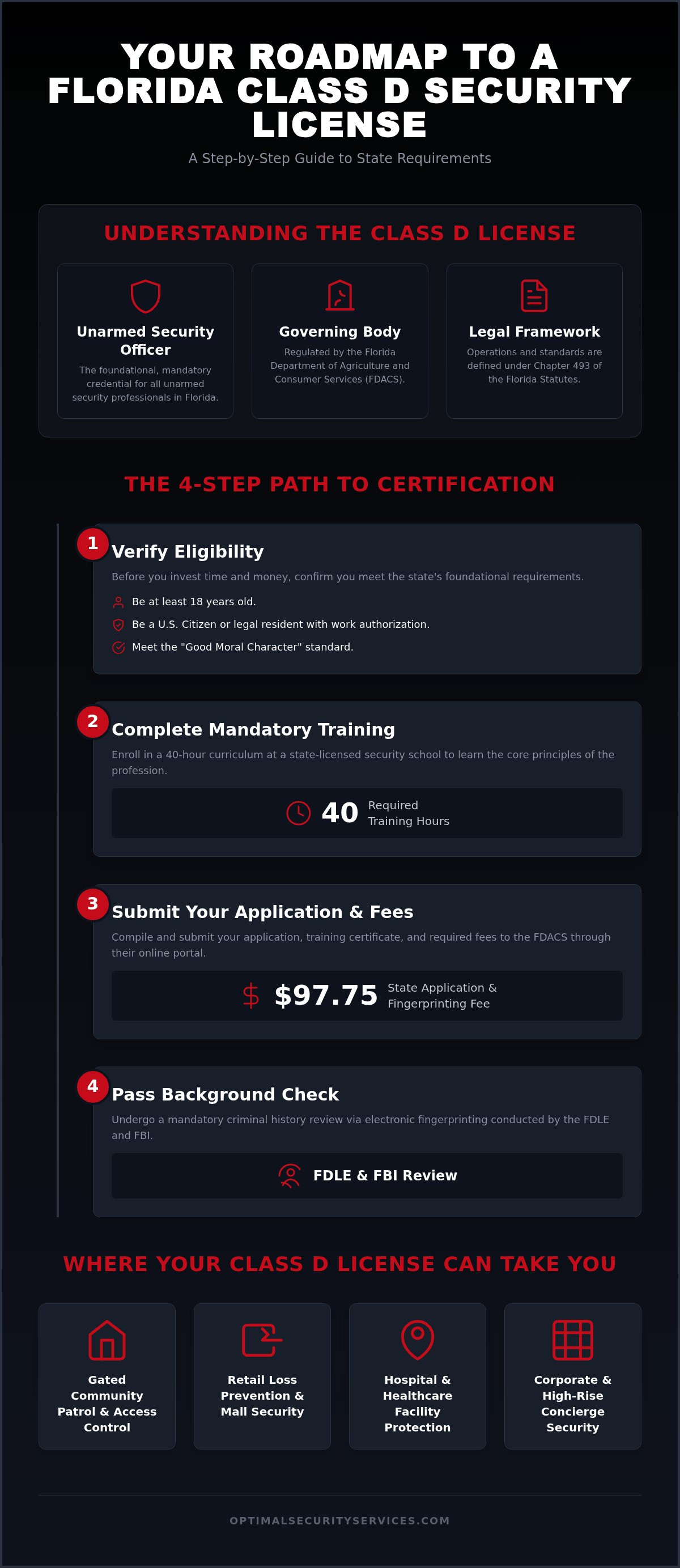
The Class D license is the primary legal requirement for any individual seeking employment as an unarmed security officer in the Sunshine State. Under Chapter 493 of the Florida Statutes, this credential ensures that every professional meets specific training and background standards before they're authorized to protect people or property. It isn't just a suggestion; it's a mandatory barrier to entry. If you're researching how to get security d license florida, you're looking at the first essential step toward a career in public safety. This license allows you to work for any licensed security agency, providing a versatile foundation for your professional life. It's a commitment to public safety and personal discipline.
While the Class D license focuses on unarmed duties, the Class G license is reserved for armed positions. You cannot hold a Class G license without first securing your Class D. Think of it as the prerequisite for everything that follows. For a broader perspective on the industry, Wikipedia's overview of security guards provides excellent context on how these roles function globally. In Florida, the distinction is clear: the Class D license covers observation, reporting, and physical presence, whereas the Class G involves firearm proficiency and additional legal liabilities.
Who Governs Security Licensing in Florida?
The Florida Department of Agriculture and Consumer Services (FDACS) maintains strict oversight of the industry through its Division of Licensing. This regulatory body ensures that every officer is vetted and every training curriculum meets the high standards of Florida Administrative Code. Choosing a state-licensed facility like Optimal Security is critical. We act as your bridge to the FDACS, ensuring your 40 hours of training align perfectly with state law. It's a matter of professional discipline and legal compliance. The state monitors these standards to maintain the integrity of the private security sector, ensuring that only qualified individuals stand watch over Florida’s communities.
Career Opportunities with a Class D License
Once you've earned your credential, the Florida job market opens significantly. You'll find opportunities in diverse environments, whether you prefer the steady pace of a corporate office or the active nature of event security. Common roles include:
- Gated community patrol and access control.
- Retail loss prevention and mall security.
- Hospital and healthcare facility protection.
- Concierge security for luxury high-rises and corporate centers.
The industry continues to grow as the demand for professional protection increases. This license is your entry point into a field that values reliability and specialized skill. It's a path toward long-term stability and career growth. Many officers use the experience gained here to transition into supervisory roles or specialize in high-tech surveillance and logistics. You're not just getting a job; you're entering a professional community that values honor and diligence.
Eligibility and Prerequisites: Are You Qualified?
You must be at least 18 years old to apply for a Class D license. You also need to be a U.S. citizen or a legal resident with valid work authorization. Florida law is strict about these foundational requirements. Understanding how to get security d license florida begins with confirming you meet these basic legal benchmarks before investing in training. It's a matter of ensuring you're legally prepared to enter a profession that demands high standards of responsibility.
The state evaluates every applicant based on the "Good Moral Character" standard. This isn't just a vague term. It's a specific professional benchmark used to ensure that those in positions of trust are reliable and disciplined. The FDACS looks for a history of honesty and professional conduct. If you've had minor legal issues in the past, don't assume you're automatically disqualified. However, transparency is the only path forward. The state prioritizes those who demonstrate a commitment to integrity and public safety.
Background Check and Criminal History
Every applicant undergoes a rigorous screening process. The Florida Department of Law Enforcement (FDLE) and the FBI review your criminal history through electronic fingerprinting. Certain convictions, particularly those involving violence, theft, or drug distribution, can be significant hurdles. The Florida Senate Bill on Security Training outlines the legal frameworks that govern how these background standards interact with professional licensing. It's better to address your history early. Disclosing everything on your application is vital. The state values integrity over a perfect record in many cases.
Residency and Identification Requirements
You'll need a valid government-issued photo ID to begin. A Florida driver's license or a state-issued ID card is the standard. If you aren't a citizen, you must provide USCIS work authorization documents. These must be current and clear. The Division of Licensing requires high-quality digital copies for their records during the online submission phase. Providing accurate documentation prevents unnecessary delays in your application processing.
Before you enroll in a school, perform a quick self-assessment. Common disqualifiers include:
- Active warrants or pending criminal charges.
- Recent felony convictions without a restoration of civil rights.
- Dishonorable discharge from the military.
- Injunctions for protection against domestic violence.
Being proactive saves you time and money. If you're confident in your eligibility, the next step is finding a reputable school. Learning how to get security d license florida involves more than just passing a test; it's about proving your reliability to the state. You can view our upcoming class schedule to see how we help students navigate these initial hurdles with professional guidance.
The 40-Hour Mandatory Training: What to Expect
The 40-hour mandatory training is the heart of your transition into the private security field. Governed by Florida Administrative Code 5N-1, this curriculum ensures that every officer possesses a standardized level of competence and readiness. When you're figuring out how to get security d license florida, the training school you choose becomes your primary partner. At Optimal Security, we move beyond simple lectures. We create a classroom environment where theory meets real-world application. You'll spend time analyzing legal statutes one hour and practicing emergency response protocols the next. This balanced approach keeps the material engaging and ensures you're prepared for the final examination, where you must demonstrate a firm grasp of state regulations and safety procedures.
Core Subjects in the Security D Curriculum
The curriculum is comprehensive, designed to prepare you for the diverse challenges of the field. You'll study the legal authority and scope of practice to understand exactly what you can and cannot do as an officer. This includes a deep dive into the Official Class D License Application Packet, which details the administrative side of your new career. Other critical topics include:
- Emergency procedures and first aid basics to handle medical crises.
- Terrorism awareness and methods for protecting critical infrastructure.
- Professional ethics and public relations strategies for modern interactions.
- Fire safety and evacuation coordination.
Developing Essential Security Skills
Technical knowledge is only half the battle. A successful officer must master practical skills that ensure safety and professional documentation. We place a heavy emphasis on report writing. Your logs and incident reports are legal documents; they must be clear, concise, and accurate. You'll also train in observation techniques, learning how to spot anomalies before they escalate into threats. This methodical training prepares you for the high stakes of the industry.
Conflict resolution is perhaps the most vital skill in your toolkit. We teach de-escalation strategies that prioritize verbal communication over physical intervention. By learning how to manage high-stress interactions with calm authority, you protect yourself, your employer, and the public. This skill set is what separates a licensed professional from an untrained observer. Our instructors guide you through mock scenarios, providing immediate feedback to sharpen your instincts. It's a disciplined process that builds your confidence. Mastering these skills is essential for anyone learning how to get security d license florida and succeed in the long term.
The Application Step-by-Step: From School to State
Transitioning from a student to a licensed professional is a process of precision. Once you've mastered the curriculum, you must navigate the administrative requirements with the same discipline you applied in the classroom. Understanding how to get security d license florida involves coordinating several moving parts, from digital fingerprints to state submission portals. It's about moving through the checklist methodically to ensure your career starts without delay. Every document must be accurate to avoid the common administrative hurdles that slow down the licensing process.
- Step 1: Training Completion. Finish your 40-hour course at a state-licensed facility.
- Step 2: Certificate Collection. Secure your official Certificate of Completion (Form FDACS-16103). This is your primary proof of readiness.
- Step 3: Livescan Fingerprinting. Visit an FDLE-approved provider. Your fingerprints must be submitted no more than 90 days before your application.
- Step 4: State Submission. Submit your application via the FDACS online portal, including the required $97.75 fee and a digital passport-style photo.
- Step 5: Monitoring. Track your status through the Division of Licensing website as they process your background check.
Navigating the Livescan Fingerprinting Process
Livescan is the modern standard for background checks. Unlike traditional ink and paper cards, electronic scans are transmitted directly to the FDLE and FBI for immediate review. You must ensure the provider uses the correct Originating Agency Identifier (ORI) code so your results link to your specific application. It's a technical but straightforward step that requires a valid photo ID. Accuracy here prevents the state from rejecting your prints, which is a common cause for licensing delays. Most students complete this step immediately after their training to keep their momentum.
Post-Application: Temporary vs. Permanent Licenses
Florida offers a path to employment even while your permanent license is being processed. Once your application is submitted and your fingerprints are clear, you may receive temporary work authorization. This allows you to begin working for a licensed agency immediately while the state finalizes your file. Your permanent hard-copy license is typically valid for two years. Maintaining this credential requires notifying the state of any address changes within 10 days to ensure you receive renewal notices. This attention to detail is part of the professional rigor expected in the industry. To begin this journey with a team that understands every detail of the process, you can enroll in our next security d license course today. We provide the guidance you need to move from the classroom to the field with total confidence.
Launching Your Career with Optimal Security Training
Securing your credential is a milestone, but the true objective is building a sustainable career in public safety. Many people research how to get security d license florida and stop once they have the paperwork. However, the quality of your initial training determines your long-term success and your ability to command respect on the job site. High-quality instruction prepares you for the realities of the field, from handling difficult public interactions to writing reports that stand up in court. Your license is your entry ticket; your professional conduct is what keeps you there. You must treat every shift as an opportunity to demonstrate the discipline you learned during your 40 hours of training.
Preparing for your first security officer interview requires a shift in mindset. Employers aren't just looking for someone who can stand at a post. They're looking for individuals who project authority, reliability, and calm under pressure. When you sit down with a hiring manager, emphasize your understanding of Florida Statutes and your commitment to de-escalation. Once you're hired, your first 90 days are critical for establishing your reputation. This period often involves agency-specific on-the-job training where you'll learn the nuances of your specific site. Success here opens the door for continuing education, such as moving from a Class D to a Class G Armed License, which significantly increases your earning potential and responsibilities.
Why Choose Optimal Security for Your D License?
We believe that a security officer's training should exceed the minimum state requirements. Our instructors bring years of real-world private security experience into the classroom, providing insights that you won't find in a standard manual. We foster a supportive environment where students can ask questions and practice scenarios until they feel confident. By choosing a specialized school, you're investing in a foundation of expertise that sets you apart from candidates who took the easiest path possible. Our curriculum is designed to ensure you're not just licensed, but truly ready for the demands of the modern Florida job market.
Your First 90 Days as a Security Officer
The initial months of your career are about observation and integration. You'll work closely with supervisors to master site-specific protocols, whether you're patrolling a gated community or managing access at a corporate office. Reliability is your most valuable asset. Showing up on time, maintaining a sharp uniform, and following post orders without deviation builds the trust necessary for career advancement. This is the time to refine the skills you practiced during your 40-hour course. To see when our next sessions begin and take the first step toward your professional future, explore our training schedule today. We're dedicated to being the bridge between your current situation and a disciplined, rewarding career.
Secure Your Future in Florida’s Private Security Industry
Navigating the state’s regulatory landscape is simpler when you have a clear, authoritative roadmap. You now understand that the Class D license is the essential credential for unarmed service; it requires both a 40-hour mandatory curriculum and a successful background check. By following the step-by-step application process and completing your Livescan fingerprints, you position yourself for immediate professional stability. Learning how to get security d license florida is the first disciplined move toward a career built on honor and reliability.
As a State-Licensed Florida Security Training Facility, we provide the expert instruction for private security careers needed to bridge the gap between classroom theory and professional field performance. Our comprehensive 40-hour mandatory curriculum ensures you meet all industry standards with confidence while preparing you for the realities of the job. We're ready to help you transition into this high-demand field with the support of seasoned professionals who value your success. Enroll in Our Next Security D License Class and begin your professional journey today. Your new career in private security is within reach.
Frequently Asked Questions
How long does it take to get a security D license in Florida?
The process begins with a mandatory 40-hour training course, which most students complete in a single business week. Once you submit your application and fingerprints to the FDACS, processing times can vary based on state volume. While the state review often takes several weeks, you can accelerate your start date by ensuring all digital documents are submitted correctly the first time. We focus on getting you through the curriculum efficiently.
Can I take the Florida Class D security course online?
Yes, Florida law permits you to complete your training through a live, instructor-led online format. This modern approach allows you to interact with experts in real-time while meeting the state's strict identity verification and attendance requirements. It's a convenient option for those researching how to get security d license florida while managing existing work or family commitments. Our digital classroom maintains the same rigor as our in-person sessions.
What is the total cost of getting a Florida security license in 2026?
The state of Florida currently requires a total fee of $97.75 for the initial application and electronic fingerprinting. This amount is paid directly to the Florida Department of Agriculture and Consumer Services during the submission process. You should also budget for the tuition of your chosen training facility, as this is a separate professional investment in your career. We recommend checking the current FDACS fee schedule for any minor annual adjustments.
Do I need a background check for a security D license?
Every applicant must undergo a comprehensive criminal history review conducted by the FBI and the Florida Department of Law Enforcement. This is completed through an approved Livescan provider who captures your fingerprints electronically. The state uses this data to ensure all officers meet the professional standards required for public safety roles. Transparency regarding your history is vital during this stage to avoid unnecessary delays or application denials.
Can I work while my Florida security license application is pending?
You can often begin working immediately if you obtain a temporary work authorization, commonly referred to as a blue card. This is issued after you've completed your training, submitted your official application, and cleared the initial fingerprint scan. It allows you to gain on-the-job experience with a licensed agency while the state finalizes your permanent hard-copy credential. This pathway helps you start earning as quickly as possible.
Does the Florida security D license expire?
The Class D license remains valid for a period of two years from the date of issuance. You're responsible for renewing your credential before the expiration date to avoid a lapse in your legal authority to work. The state typically sends renewal notices to your address on record, so keeping your contact information current with the Division of Licensing is essential. Regular renewals ensure you remain in good standing with the state.
What happens if I fail the security D license exam?
If you don't pass the final examination on your first attempt, you're typically permitted to retake the test after additional study. Our instructors focus on student retention and practical application to ensure you're fully prepared for the first attempt. We provide a supportive environment that emphasizes professional readiness, helping you master the legal and safety material required to succeed. Your success is our primary goal during the training process.
Are there exemptions for the 40-hour training requirement?
Exemptions are available for individuals with specific professional backgrounds, such as active law enforcement officers or recently discharged military personnel with equivalent training. These candidates may be able to bypass the 40-hour curriculum by providing official documentation of their service and experience to the state. You should verify your specific eligibility with the FDACS Division of Licensing before enrolling in a course. We can help you determine if your background qualifies for these exemptions.


